
Concrete Pump Pipe Compliance Guide: Matching DN150 Specs to Global Import Documentation
A DN150 concrete pump pipe order clears import review when three things agree: the model code written on the purchase order, the physical parts inside the crate, and the documents that travel with them. When any one of the three drifts, the shipment stops — at the supplier's loading bay, at the port inspection, or at the project gate.
This guide is a cross-check procedure for importers, distributors and project procurement teams buying DN150 delivery line components. It uses one worked specification set to make the checks concrete: the 150L=3000 straight pipe, the 150R400*90° elbow, the 150A clamp and the 150-125 L=1200 reducer, supplied by Hongchang Machinery Technology Co., Ltd., a concrete pump pipe manufacturer based in Ma'anshan City, Anhui Province, China, producing straight pipes, elbows, clamps and reducers.
Problem Definition: Why “DN150” Is Not a Specification
DN150 defines nominal diameter and nothing else. It does not define wall thickness, material grade, hardness, bend radius, end connection or surface treatment — and each of those variables changes what the part is, what it costs, and how it is declared at the border. A purchase order that reads only “DN150 elbow, 90°” is an instruction to guess.
Model shorthand that looks identical and is not
The digit string 150 appears in four different model codes in this set, and each one identifies a different part:
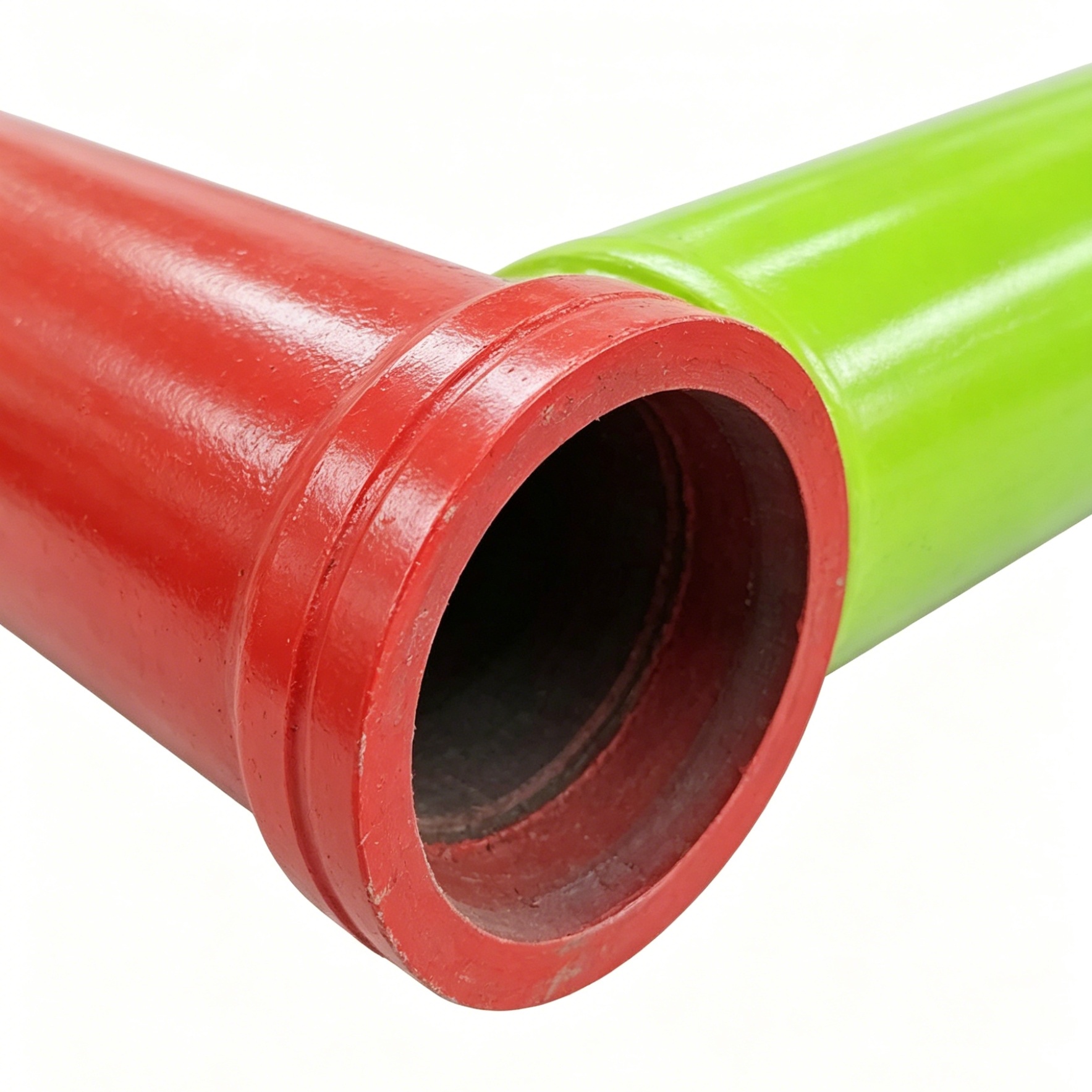
- 150L=3000 — a DN150 straight pipe, 3,000 mm long.
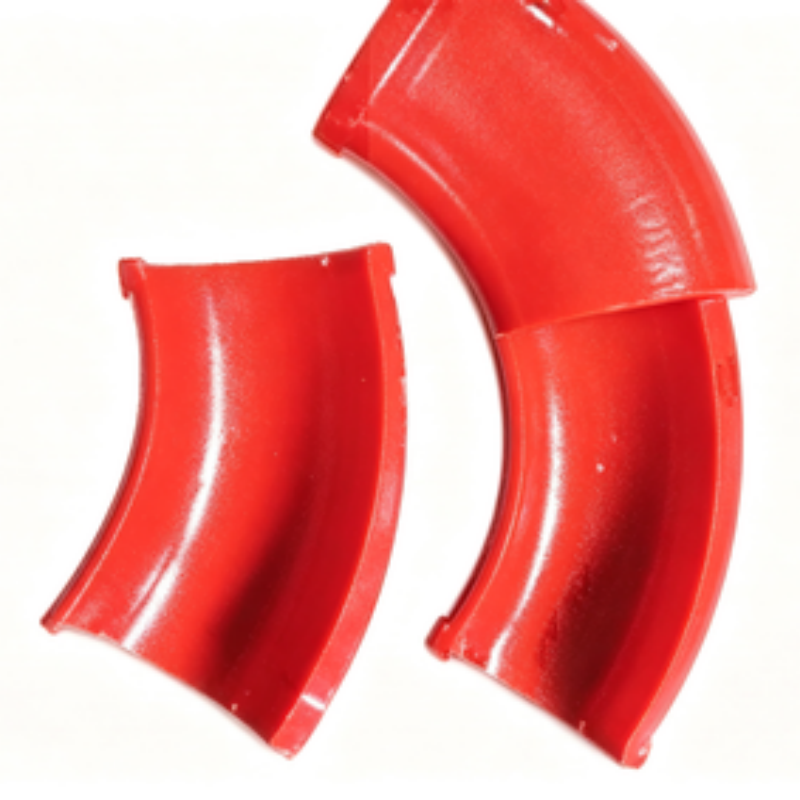
- 150R400*90° — a DN150 elbow with a 400 mm bend radius at a 90° angle.
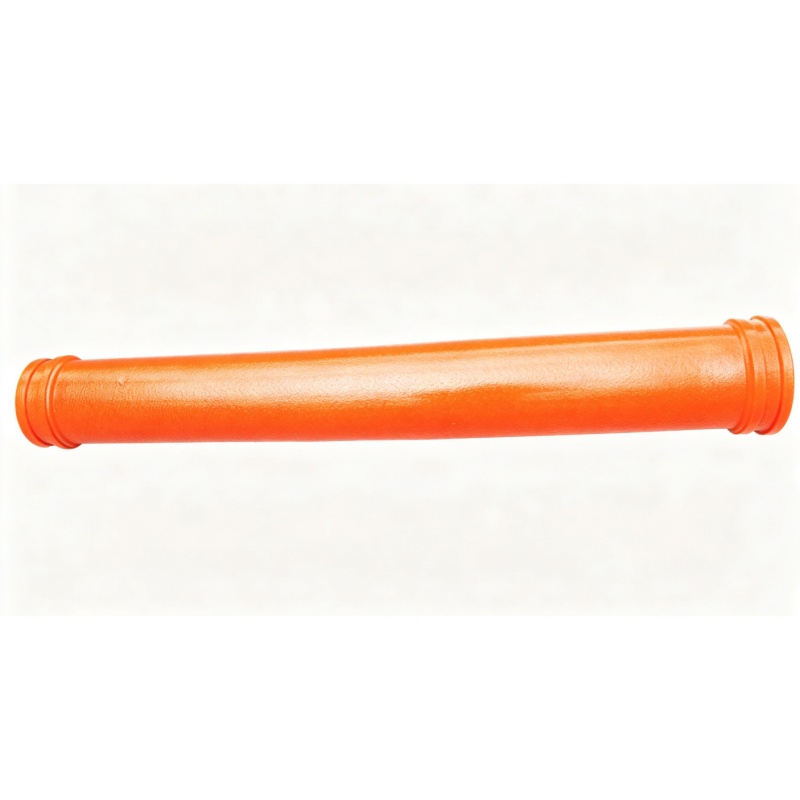
- 150A — a clamp sized for DN150 pipe.
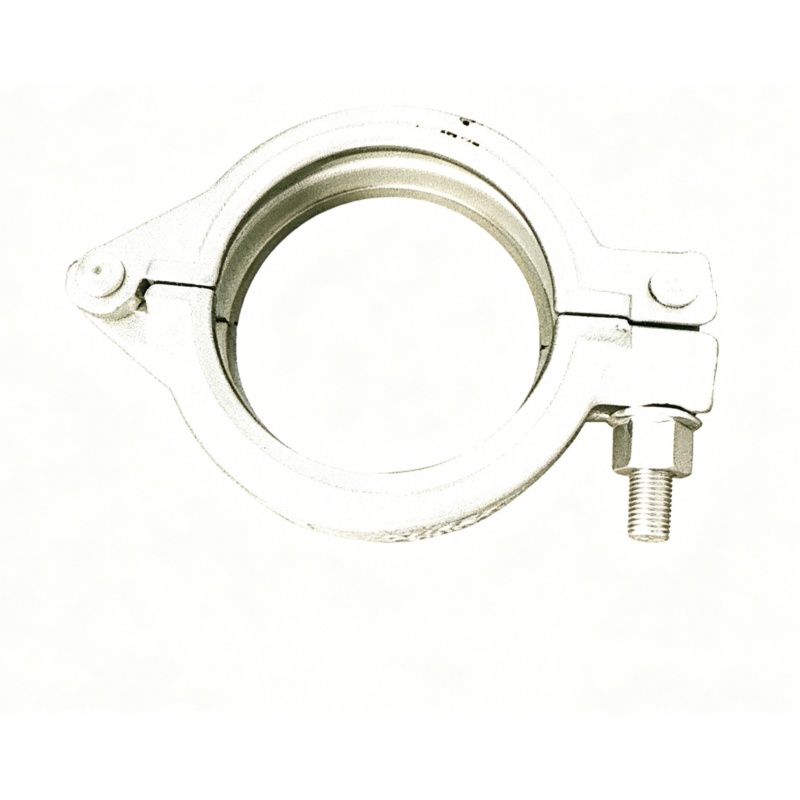
- 150-125 L=1200 — a DN150-to-DN125 reducer transition, 1,200 mm long.
Written shorthand such as “150 elbow” or “150 connector” collapses these into a single ambiguous line item, and ambiguity is the first thing an inspection team flags.
Material named without a grade
Straight pipe in this range is produced in 20# steel or quality alloy structural steel. Elbows are produced in wear-resistant cast steel or high-strength carbon steel, formed by integral casting or welded forming, then heat treated with the inner wall quenched. “Steel” is not a grade, and an invoice that says “steel pipe” gives an inspector nothing to verify against.
Hardness quoted without an attached record
The HRC 55–62 figure belongs to the quenched alloy steel straight pipe in this set. It is not a universal value that can be transferred to clamps, reducers or cast elbows. A hardness number on a quotation is a claim; a hardness test record tied to a batch is evidence.
Certification used as a substitute for product records
ISO 9001:2015 is a quality management system certification. It indicates that a manufacturer operates a documented quality system within a defined scope; it does not certify that a specific pipe meets a specific dimensional, hardness or pressure requirement. Separately, ISO 21573-1:2024 establishes the content for commercial specifications for concrete pumps used on building sites for concrete-mix delivery — it is a pump-level specification standard, not a pipe certificate. Treating either document as product conformity evidence is one of the most common documentation errors in this category.
Industry Background: The Delivery Line Inside the Pumping System
The delivery line is a component set inside a pumping system rather than a standalone steel product. Manufacturer technical literature describes a trailer concrete pump as consisting of a pumping unit, a receiving hopper, a delivery valve, pumping cylinders and pistons, and a hydraulic system; the pipe line carries the mix from that system to the pour point (CIFA). Buying pipe without reference to the pump configuration, the delivery height and the duty cycle produces orders that are technically compliant and operationally wrong.
Demand tracks the pump fleet. The global concrete pumps market was estimated at USD 10.45 billion in 2024 and projected to reach USD 11.06 billion in 2025, according to Market Research Future. Pipe and elbow consumption follows that installed base and its replacement cycle, not new-machine sales alone.
Duty varies sharply by project type, and duty decides which documents matter most. High-rise building pumping runs continuous 8–12 hour days at high pressure with wear resistance as the governing requirement. Tunnel construction reverses direction 90–180° under heavy duty operation with abrasion resistance as the constraint. Bridge construction depends on pipe diameter transition with a precision fit. Underground mining can run 24/7 with combined corrosion and wear resistance requirements.
Detailed Solution: The Four-Component Spec Set
A DN150 line documents cleanly when the order is written as four fully specified components rather than one generic line item. The reference set below is the working example used throughout this guide.
Straight pipe — 150L=3000
Scope: DN150, length 3,000 mm. Material: 20# steel or quality alloy structural steel, single layer construction, with the alloy option quenched to HRC 55–62. Published design life bands with their corresponding cost-performance ratios are 7,000–8,000 m³ at ratio 1, 25,000–40,000 m³ at ratio 1.6, and 40,000–50,000 m³ at ratio 3.0. What the buyer documents: the material grade actually supplied, because the three life bands are not interchangeable and the price difference between them is real.
Elbow — 150R400*90°
Scope: DN150, bend radius R400, 90° angle. Material: wear-resistant cast steel or high-strength carbon steel, produced by integral casting or welded forming, then heat treated with the inner wall quenched. Standard angle options across the elbow range are 90°, 45°, 30° and 15°, with bend radii of R180, R190.5 and R275 available and further customization possible. What the buyer documents: the exact angle and radius, because a 90° R400 elbow and a 90° R275 elbow are different parts with different part numbers and different wear behaviour.
Clamp — 150A
Scope: DN150. Material: high-quality cast iron or cast steel, integral casting plus precision machining, finished with shot blasting and anti-rust spraying. Compatible diameters across the clamp range are DN100, DN125 and DN150, with customization available. What the buyer documents: the clamp model paired to the pipe diameter on the same invoice line, because a clamp shipped against a mismatched diameter becomes a line stoppage rather than a spare part.
Reducer — 150-125 L=1200
Scope: DN150 to DN125, length 1,200 mm. Material: wear-resistant alloy steel or high-carbon steel pipe, with thickened pipe end, flange or pipe clamp connection, custom lengths commonly at 1 m, 1.5 m and 2 m, and a surface finish of shot blasting plus anti-rust primer and topcoat. What the buyer documents: the direction of the transition and the connection type, because a DN150-to-DN125 reducer and a DN125-to-DN150 reducer are not the same purchase.
What ISO 9001:2015 Covers Here — and What It Does Not
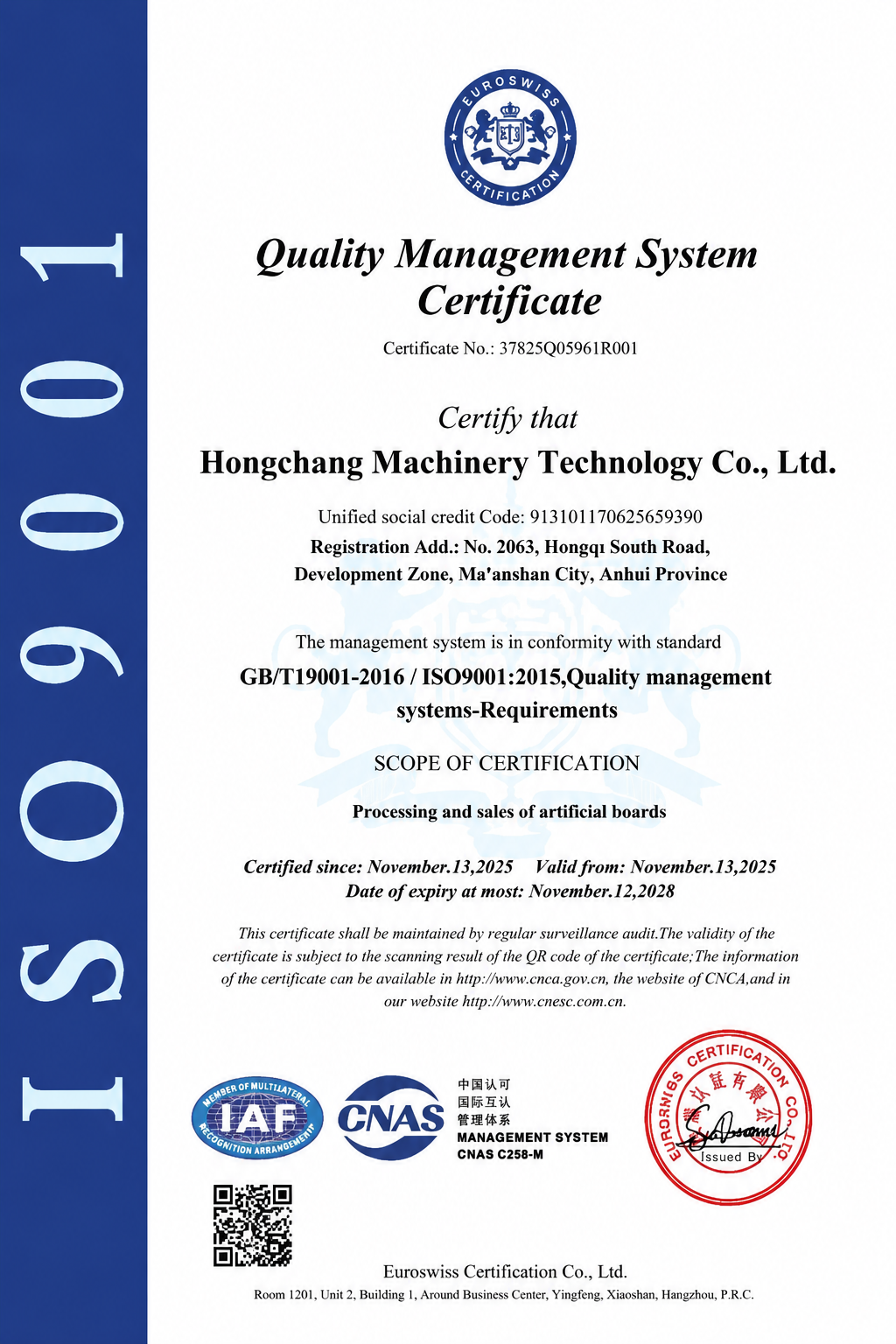
Hongchang Machinery Technology holds ISO 9001:2015 certification, certificate number ISO-2024-HC, issued by a Certification Body for the global market with a scope of Manufacturing Quality. The certificate is valid from 2025-11-13 to 2028-11-12 and applies to the Double-layer Elbow together with the related straight pipe, elbow, clamp and reducer products in this set.
That is a management system statement with a defined scope and an expiry date, and it should be read that way. It supports a supplier qualification file. It does not replace a material grade declaration for the steel actually used, a hardness test record covering the delivered batch, a dimensional inspection record, a pressure test record where the buyer contracts for one, or a destination-market conformity declaration where the importing country requires one. If a supplier cannot separate those documents from the management system certificate, that is itself an evaluation signal. Where a market requires CE marking or a declaration of conformity, request the declaration itself and the regulation it references; a QMS certificate is not a substitute for either.
Step-by-Step Breakdown: Cross-Checking a DN150 Order Before Shipment
Step 1 — Convert the purchase order into full model codes
Rewrite every line using the complete model code plus the attributes the code does not carry: diameter, length or angle, bend radius, material grade, hardness target, end connection and surface treatment. A line reading “150L=3000, DN150, 20# steel, single layer, 3,000 mm” can be inspected at arrival. A line reading “150 pipe” cannot.
Step 2 — Map each component to its function in the line
Straight runs, direction changes, diameter transitions and joints carry different duty and fail differently. Elbows absorb the abrasion at direction changes; reducers carry the bore transition; clamps hold the joint. Ordering against function prevents the common error of over-specifying straight pipe while under-specifying the elbows that wear first.
Step 3 — Attach a test record to every quantitative claim
For each number on the quotation, name the record that proves it. Hardness at HRC 55–62 on quenched alloy straight pipe needs a hardness test record. Dimensions need a dimensional inspection record. Where a pressure requirement is agreed, it needs a pressure test record with the test method and acceptance value written down. Hongchang's stated quality control covers 100% inspection, pressure testing, hardness testing and dimensional checks; the buyer's task is to receive the resulting records, not just the assurance that checks took place.
Step 4 — Assemble the document pack
The checklist table below defines what belongs in the pack. The pack is complete when an inspector can trace each invoice line to a physical marking and a test value without asking a question.
Step 5 — Run a three-way reconciliation
Compare purchase order, commercial invoice and inspection record line by line. Model code, quantity, diameter, length, angle and material grade must agree across all three. Differences are resolved before the container is sealed, not after arrival, when rework and return freight are the buyer's cost.
Step 6 — Confirm the customs heading in the destination market
Classification is not settled by the product name. A US Customs and Border Protection ruling (HQ 966927) places concrete pump pipes under HS 7304 for seamless steel pipes or 7306 for welded steel pipes when treated as piping, or 8413.91 when treated as parts of pumps. Which heading applies depends on how the goods are declared and on the importing jurisdiction's interpretation, so confirmation should come from a customs broker in the destination market, working from the actual specification and the declared end use. One practical consequence: a change of construction from seamless to welded can change the declared heading, so the specification freeze in Step 1 should happen before the broker is asked for an opinion.
Step 7 — Archive the record set per shipment
Keep the reconciled pack together with the batch identification. Repeat orders reference it, and a later dispute is settled by document rather than by memory.
Documentation Checklist: What to Request From a Supplier
| Document | Issued by | What it must show |
|---|---|---|
| Commercial invoice with full model codes | Supplier | Model code, diameter, length or angle and radius, material grade, quantity — matching the purchase order line by line |
| Packing list with batch marking | Supplier | Which bundle or heat mark corresponds to which invoice line |
| Material grade declaration or mill certificate | Supplier or steel mill | The grade actually used: 20# steel, quality alloy structural steel, wear-resistant cast steel or high-carbon steel |
| Hardness test record | Supplier quality control | Measured HRC values against the agreed target, tied to the delivered batch |
| Dimensional inspection record | Supplier quality control | Diameter, length, angle, bend radius and connection dimensions for each model |
| Pressure test record (where agreed) | Supplier quality control | Test method, test value and acceptance criterion |
| Quality management certificate copy | Certification body | ISO 9001:2015, certificate number, scope and validity dates |
| Destination conformity declaration (where required) | Supplier or notified body | The specific regulation cited and the product scope it covers |
| Customs classification confirmation | Buyer's customs broker | The heading that applies in the destination market for the goods as declared |
Use Cases: Which Documents Matter Most by Project Type
High-rise building pumping
Continuous 8–12 hour pumping days at high pressure make wear life and hardness the governing variables. A construction company running 50 units on a high-rise project over three years reported stable operation and a 30% longer lifespan with hardness in the HRC 58–62 band. The documents that carry that result are the hardness record and the material grade declaration, because that is where the reported life came from.
Tunnel construction
Tunnel lines reverse direction 90–180° under heavy duty operation, so elbows take the abrasion load. The documents that matter are the elbow angle and radius as written on the invoice, the material and heat treatment statement, and the dimensional record for the bend. A radius deviation that looks minor on paper changes the wear pattern over the life of the line.
Bridge construction
Bridge work depends on pipe diameter transition with a precision fit, which puts the reducer at the centre of the order. The documents that matter are the reducer direction (DN150 to DN125 in the 150-125 L=1200 case), the connection type — thickened pipe end, flange or pipe clamp — and the dimensional inspection record for the transition.
Mining and slurry transport
Mining duty can run 24/7 with combined corrosion and wear resistance requirements. A mining company using 100 meters of pipe underground over four years reported a 40% reduction in maintenance. The documents that matter are material grade, hardness, and the batch identification that allows a repeat order to reproduce the same construction.
Equipment OEM integration
An equipment OEM integrating 200 pieces into pump truck manufacturing over two years reported successful OEM integration, with custom specifications and quality consistency as the deciding factors. The documents that matter are the drawing or specification sheet the parts were built to, plus the dimensional record proving conformance to it. Hongchang operates OEM/ODM production with custom specifications, logo printing, brand packaging and custom lengths, and is a designated supporting manufacturer for Xingma Automobile, with pipes matched to pump trucks and tow pumps from Sany Heavy Industry and Zhonglian Heavy Industry.
Comparison Table: DN150 Spec Set and the Document Behind Each Line
| Component | Model code | Specification | Document to request |
|---|---|---|---|
| Concrete Pump Straight Pipe | 150L=3000 | DN150, L=3,000 mm; 20# steel or quality alloy structural steel; single layer; quenched alloy version HRC 55–62; design life bands 7,000–8,000 / 25,000–40,000 / 40,000–50,000 m³ | Material grade declaration plus hardness test record |
| Concrete Pump Elbow | 150R400*90° | DN150, R=400, 90°; wear-resistant cast steel or high-strength carbon steel; integral casting or welded forming with heat treatment and inner wall quench | Angle and radius confirmed on the invoice plus dimensional record |
| Double-layer Elbow | 275*90° | DN100 / DN125 / DN150; 90° / 45° / 30° / 15°, customizable; R180 / R190.5 / R275, customizable; quenched inner wall; anti-rust primer and topcoat | Layer construction statement plus quench and hardness record |
| Concrete Pump Clamp | 150A | DN150; high-quality cast iron or cast steel; integral casting with precision machining; shot blasting and anti-rust spraying | Model-to-diameter pairing plus dimensional record |
| Reducer Pipe | 150-125 L=1200 | DN150 to DN125, L=1,200 mm; wear-resistant alloy steel or high-carbon steel pipe; thickened pipe end, flange or pipe clamp connection | Transition direction and connection type plus dimensional record |
Product specifications as published for the Hongchang range. The document column lists buyer-side controls; it does not describe certifications held by the products.
FAQ
What documents should accompany a DN150 concrete pump pipe order?
At minimum: a commercial invoice carrying the full model code, diameter, length or angle and radius, and material grade for each line; a packing list linking bundles to invoice lines; a material grade declaration or mill certificate; a hardness test record where hardness is specified; and a dimensional inspection record. Where a pressure requirement is agreed, add a pressure test record with the method and acceptance value. A copy of the ISO 9001:2015 certificate, with number, scope and validity dates, supports supplier qualification but does not replace any of the product-level records above.
Can a supplier deliver a non-standard angle, bend radius or length, and how is it verified?
Customization is available across the range: elbow angles at 90°, 45°, 30° and 15° with radii of R180, R190.5 and R275 and further customization on request; clamp diameters at DN100, DN125 and DN150; reducer lengths commonly at 1 m, 1.5 m and 2 m. Verification is dimensional, not verbal. Request the inspection record for the specific custom dimension on the specific model — a generic catalogue page does not confirm a non-standard build.
Why do two DN150 straight pipes of the same length differ in price?
Because the material and construction differ. The DN150 3,000 mm straight pipe in this set is offered in 20# steel or quality alloy structural steel, single layer, with design life bands of 7,000–8,000 m³, 25,000–40,000 m³ and 40,000–50,000 m³ and corresponding cost-performance ratios of 1, 1.6 and 3.0. Comparing a quotation from the 7,000–8,000 m³ band against one from the 40,000–50,000 m³ band without matching the material is not a price comparison; it is a comparison of two different products.
Can a buyer test one piece before committing to a full container?
Yes. Minimum order quantity is 1 piece for a sample order, which allows the buyer to verify diameter, wall thickness, bend radius, connection fit and surface finish against the specification before scaling up. A sample also lets the buyer confirm that the delivered record set matches the delivered part, which is the point of the whole exercise.
What is the lead time for a DN150 order, and what affects it?
Standard lead time is 15–30 days. Position within that window depends mainly on whether the order stays inside standard specifications or moves into custom angles, radii and lengths, on order quantity against a monthly capacity of 50,000 meters of straight pipe and 15,000 pieces of curved pipe, and on whether batch-level test records must be issued together with the shipment. If the document pack is required before departure rather than after arrival, confirm that at the quotation stage — it is easier to schedule than to retrofit. To move from specification review to a verified order, request the document pack and a sample piece directly from the manufacturer.
Conclusion
Compliance in this category is not decided by a logo on a certificate. It is decided by whether four model codes — 150L=3000, 150R400*90°, 150A and 150-125 L=1200 — are written on the order with their diameter, length, angle, radius, material grade and hardness, and whether each of those attributes can be traced to a record that travels with the cargo. The management system certificate supports the supplier; the product records support the shipment. Buyers who separate the two stop discovering mismatches at the port and start finding them on the quotation.
Next Step: Request the Document Pack and a DN150 Sample
Hongchang Machinery Technology Co., Ltd. supplies concrete pump pipes, elbows, clamps and reducers with OEM/ODM production, custom specifications, logo printing, brand packaging and custom lengths. Sample orders start at 1 piece, with a standard lead time of 15–30 days.
Contact: Chen Zhen
Address: No. 2063, Hongqi South Road, Development Zone, Ma'anshan City, Anhui Province, China
Tel / WhatsApp: +86-13301770177
Email: chenzhen@hongchangpumpipe.com
Website: www.hongchangpumpipe.com
Have Questions or Need More Details?
Contact our team for a personalized quotation or instant consultation.
Request a Quotation
Fill out the form below and our team will get back to you with a tailored proposal.
WhatsApp Direct Chat
Prefer to chat in real-time? Message us on WhatsApp for instant assistance & quick answers.
- Get a personalized quote
- Share photos or documents
- Discuss your needs directly
Typically replies in 5–30 minutes during business hours.