Reading Concrete Pump Pipe Spec Sheets: Certification, Hardness, and Cost-Performance
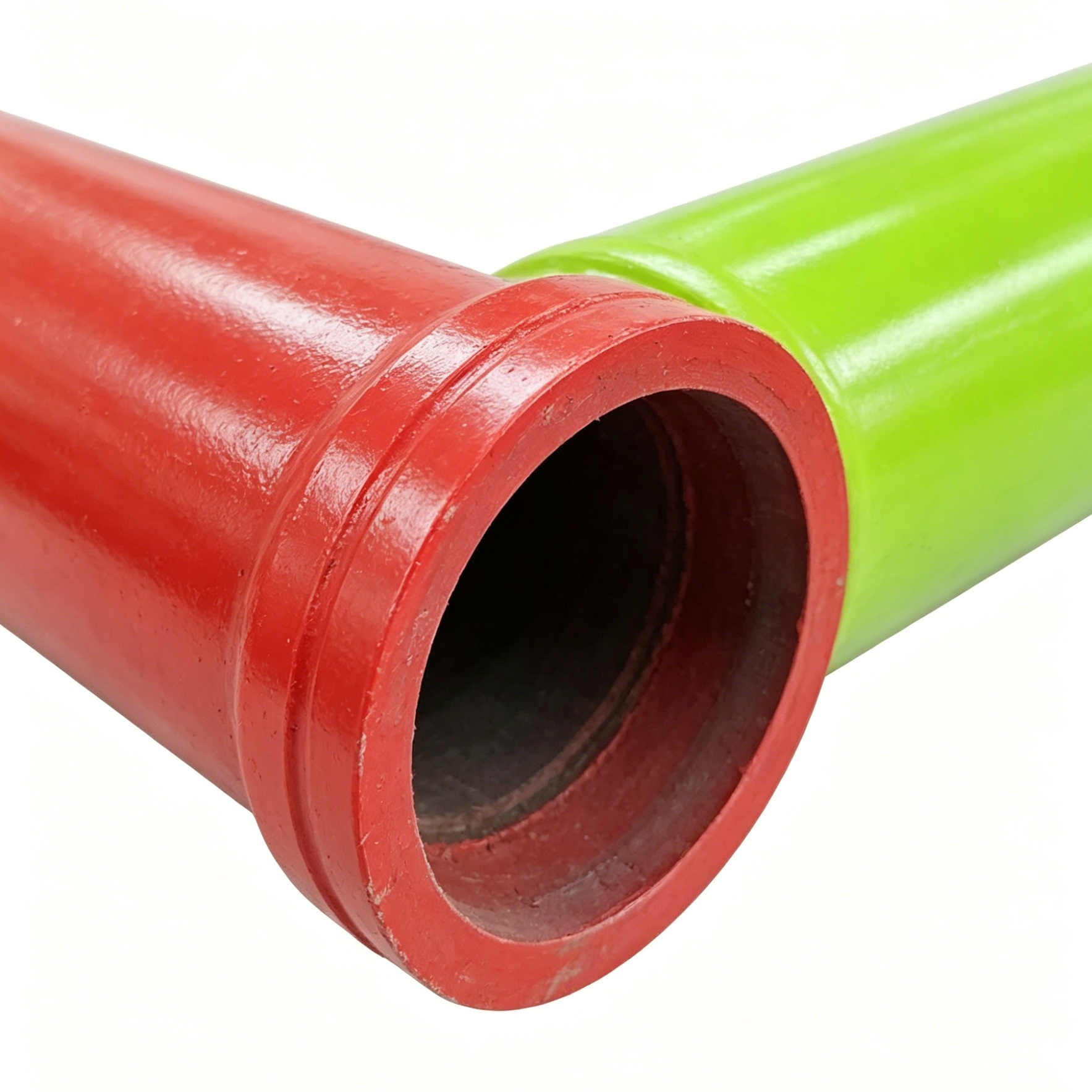
Wear-resistant concrete pump straight pipe — quenched inner wall, HRC 55-62
Reading Concrete Pump Pipe Spec Sheets: Certification, Hardness, and Cost-Performance
A concrete pump pipe spec sheet is a compact set of engineering claims. It names a diameter, an angle, a bend radius, a material, a heat-treatment method, and sometimes a service-life range. For an engineer or procurement professional, the challenge is deciding which items are genuine constraints and which are merely descriptive.
In practice, the most useful concrete pump pipe specifications for supplier screening fall into four groups: certification, material and hardening parameters, service-life and cost-performance bands, and geometric or connection data. Certification tells you whether the manufacturing quality system is audited. Material and hardening parameters tell you how the pipe will resist abrasive concrete. Service-life and cost-performance data help you convert pipe price into lifecycle cost. Geometric and connection data tell you whether the pipe will fit your pump, boom, or ground line.
The Problem With Comparing Concrete Pump Pipe Data Sheets
Most buyers do not reject a pipe because the steel grade looks weak. They reject it after premature wear stops a pour, or after a clamp leaks under pressure. The root cause is usually the same: the specification sheet was read as a list of dimensions instead of a set of constraints.
Different suppliers describe similar products in different ways. One supplier may emphasize wall thickness while omitting inner-wall hardness. Another may print ISO 9001 on the brochure without stating the certificate number or validity period. A third may claim a wear-resistant pipe but show no service-life range that a buyer can compare. When these documents are incomplete, price becomes the only common denominator, and the buyer ends up comparing numbers that do not measure the same property.
The impact of this mistake grows with project severity. High-rise concrete pumping can run 8-12 hours per day and requires pressure resistance and wear resistance. Tunnel construction creates 90-180 degree direction changes under heavy-duty operation. Mining slurry transport can run 24/7 with both abrasive and corrosive wear. A concrete pump pipe specification that looked acceptable on paper may fail far earlier in these conditions.
Industry Context: Why Specification Discipline Matters in 2026
The concrete pump market is expanding. Global market estimates place concrete pump market size near USD 6.05 billion in 2024, with expected growth at a CAGR of about 5.13% through 2032. Asia Pacific accounted for an estimated 42% of concrete pump market revenue in 2025, driven largely by infrastructure activity in China and India. Truck-mounted concrete pumps represented an estimated 48% market share in 2025 due to their mobility in urban construction.
Europe adds another layer of compliance pressure. EN 12001:2012 specifies safety requirements for conveying, spraying, and placing machines for concrete and mortar. For any supplier aiming at European projects, this type of standard becomes part of the technical qualification conversation. In parallel, the growing use of high-pressure delivery systems has increased attention to wear-resistant pipe designs and connection reliability.
For a manufacturer exporting 50% of its production, specification consistency across markets is not optional. Hongchang Machinery Technology Co., Ltd. is a concrete conveying pipe manufacturer based in Ma'anshan City, Anhui Province, China. The company was founded in 2015 and operates a 2,600 m² facility with more than 50 employees. Its annual capacity is 50,000 meters of straight pipes and 15,000 pieces of curved pipes. It exports to Southeast Asia, the Middle East, Europe, and the Americas, which means its pipe specifications must be readable by buyers working with different pump brands and different local compliance expectations.
Detailed Solution: How to Read Concrete Pump Pipe Specifications
1. Treat Certification as a Minimum Entry Condition
Certification says something about the manufacturing system, not necessarily about the wear life of a single pipe. Still, it is the first filter a buyer should apply.
Hongchang holds ISO 9001:2015 certification under certificate number ISO-2024-HC. The certificate was issued by a Certification Body on 2025-11-13 and expires on 2028-11-12. It applies to the global market, and the related product range in the company certification record includes concrete pump straight pipes, elbows, double-layer elbows, reducer pipes, and clamps. For buyers, this kind of documentation confirms that the supplier operates a quality management system covering its manufacturing quality processes.
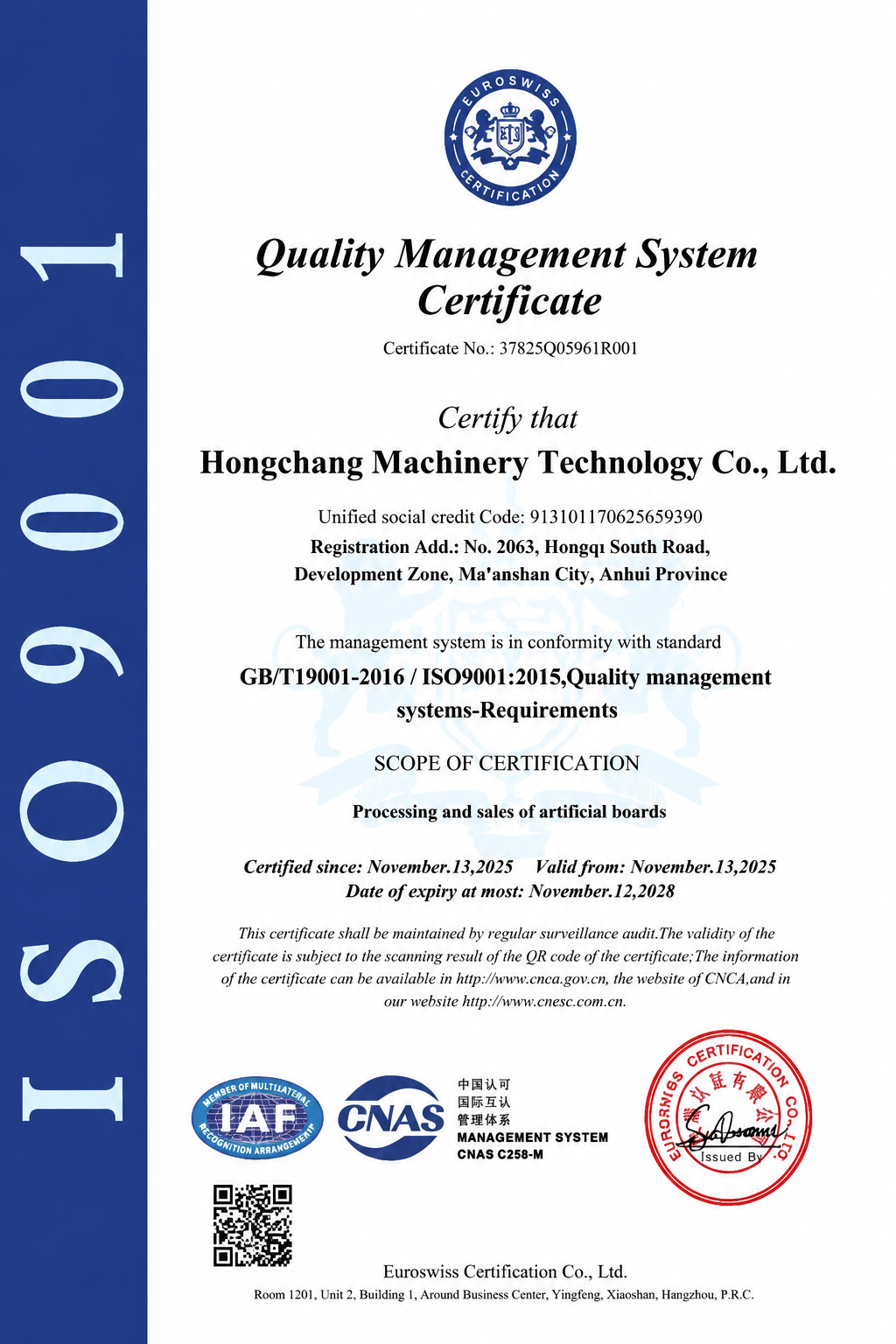
ISO 9001:2015 certification — certificate number ISO-2024-HC
What ISO 9001 does not do is assign a performance rating. It does not tell you how many cubic meters a pipe will deliver before wear-out. That is why certification should be checked first, but never treated as the final proof of product capability.
2. Read Hardness and Heat-Treatment Data as Wear-Resistance Evidence
The inner wall of a concrete pump pipe is what takes the abrasion. For a straight pipe, the main evidence of wear resistance is material grade plus heat-treatment hardness. Hongchang lists 20# steel and quality alloy structural steel as base materials for straight pipes. The wear-resistant straight pipe can be supplied with a quenched inner wall reaching HRC 55-62.
For elbows, the manufacturing route matters as much as the material. A concrete pump elbow may be formed by integral casting or by welded forming. Both routes can be followed by heat treatment and inner-wall quenching. The material options listed by Hongchang for elbows include wear-resistant cast steel and high-strength carbon steel. For the double-layer elbow, the construction uses a quenched inner wall, and available nominal diameters are DN100, DN125, and DN150. Angles can be 90 degrees, 45 degrees, 30 degrees, or 15 degrees; bend radius options include R180, R190.5, and R275, with customization available.
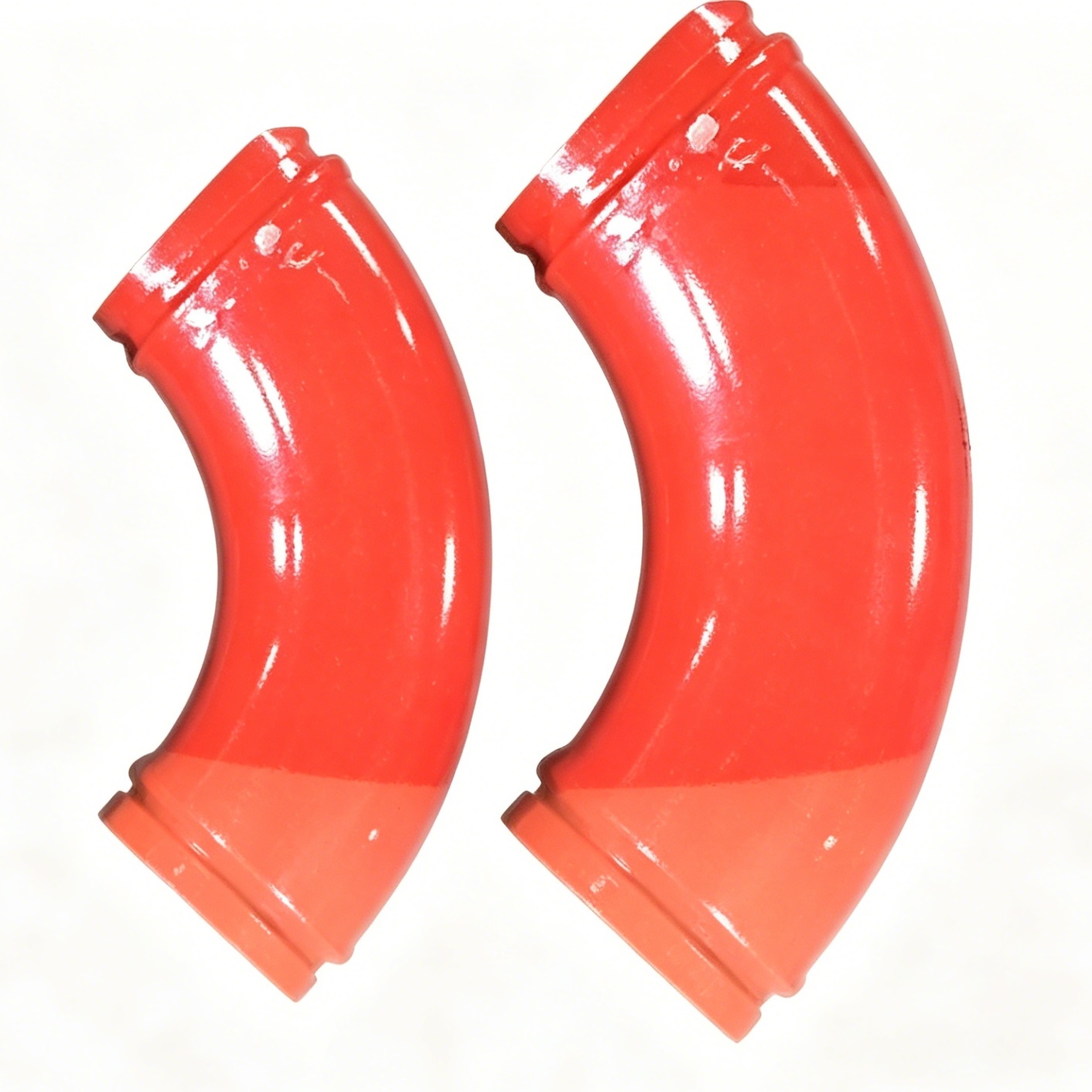
Concrete pump pipe elbow — cast steel, heat-treated, quenched inner wall
Hardness alone is not a complete answer. A buyer should also ask whether the hardness is surface hardness or through-wall hardness, which process creates it, and whether the base pipe can withstand the pressure of the application. The practical reading rule is this: if a supplier does not state its hardening method or hardness range, the spec sheet is incomplete for a wear-resistance decision.
3. Use Service-Life and Cost-Performance Data for Total Cost Thinking
Concrete pump pipe specification sheets often reveal their real commercial logic through service-life bands. Hongchang's product data for concrete pump straight pipes shows three design-life levels: 7,000-8,000 m³, 25,000-40,000 m³, and 40,000-50,000 m³ of concrete pumped. The corresponding cost-performance factors are 1, 1.6, and 3.0.
These numbers should be read together. A pipe priced at 1.6 times the standard grade may deliver roughly three to five times the volume. A pipe priced at 3.0 times the standard grade may deliver up to 50,000 m³. The exact multiple varies by grade, but the direction is clear: the lowest first price is not automatically the lowest cost per cubic meter.
Hongchang also states that its straight pipes and curved pipes are designed as resource-saving products with a lifespan 2-3 times that of ordinary products. In a project with thousands of cubic meters of pumping, the buyer should estimate how many pipe replacements the project will require at each specification level. A higher-grade pipe can reduce the number of replacements, the time lost on the worksite, and the labor cost of changing pipes and clamps.
4. Verify Dimensions and Connection Details Against Your Pump System
The final layer of a concrete pump pipe specification is mechanical fit. A correct material grade and a high HRC value are useless if the pipe cannot be connected to the pump outlet, boom line, or ground line.
Standard concrete pump pipe diameters in Hongchang's product line include DN100, DN125, and DN150. Straight pipes are available in lengths such as 3,000 mm. Reducer pipes connect different diameters; the model 150-125 L=1200, for example, transitions from DN150 to DN125. Elbow bend radii should be chosen according to the space available on the boom or in the tunnel, because a tighter radius changes the abrasion pattern of the concrete.
Connection methods also belong in the verification list. Hongchang reducer pipes can use thickened pipe ends, flanges, or pipe clamp connections. The concrete pump clamp is manufactured from high-quality cast iron or cast steel, with compatible diameters of DN100, DN125, and DN150, and it uses an integral casting and precision machining process. Quick-fitting clamp systems are common on vehicle-mounted and ground pump lines because they reduce changeover time when pipe sections are rotated to spread wear.
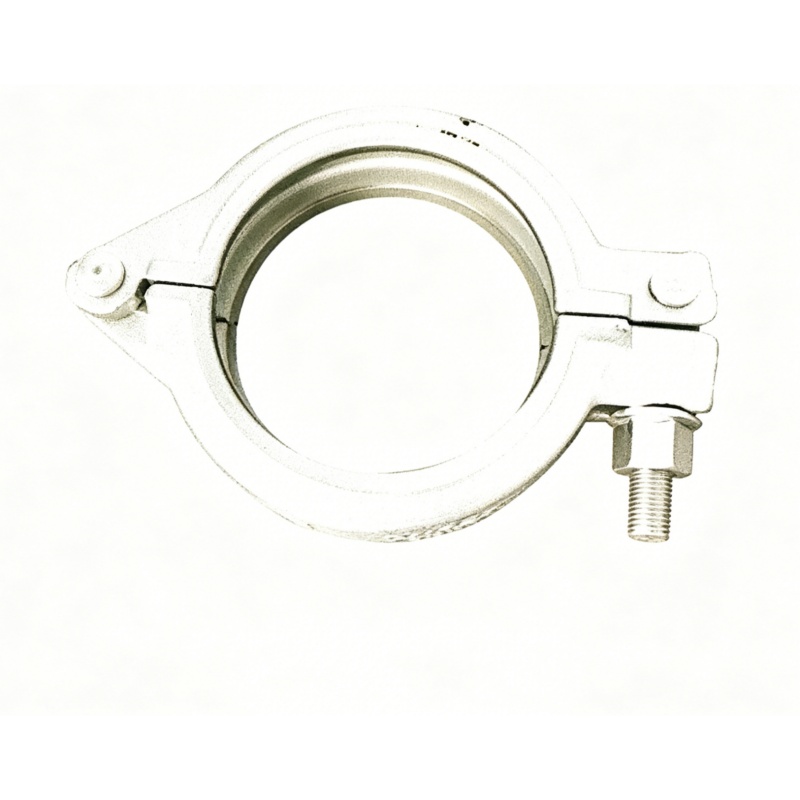
Cast concrete pump pipe clamp — integral casting and precision machining
Step-by-Step: A Concrete Pump Pipe Specification Verification Workflow
Use the following sequence when evaluating pipe suppliers for a new project or a second-source qualification.
Step 1: Define the project constraints. Identify whether the line will operate in high-rise construction, tunnel construction, bridge infrastructure, or mining. Record the daily operating hours, expected total concrete volume, pressure level, and the required direction changes.
Step 2: Check the certification document itself. Look for the standard name, certificate number, issuing body, issue date, expiry date, and market scope. For Hongchang, the relevant certificate is ISO 9001:2015, number ISO-2024-HC, issued on 2025-11-13 and valid until 2028-11-12 for the global market.
Step 3: Review material and manufacturing statements. Confirm whether the product is listed as 20# steel, alloy structural steel, cast steel, or high-strength carbon steel. Confirm whether the process is integral casting, welded forming, or double-layer construction.
Step 4: Ask for hardness evidence. If the pipe is presented as wear-resistant, request the inner-wall hardness range and the heat-treatment process. For Hongchang straight pipes, the published quenched inner-wall hardness is HRC 55-62.
Step 5: Convert service life into cost. Compare the published design-life bands and cost-performance factors. For a straight pipe, the bands are 7,000-8,000 m³ at factor 1, 25,000-40,000 m³ at factor 1.6, and 40,000-50,000 m³ at factor 3.0.
Step 6: Check dimensions and connections against your fleet. Match the nominal diameter, angle, bend radius, length, and connection type to the pump truck, trailer pump, or ground pump system. Confirm whether the supplier can adapt to models such as Sany Heavy Industry and Zhonglian Heavy Industry equipment. Hongchang states that its pipes can be matched with pump trucks and tow pumps from these manufacturers and is a designated supporting manufacturer for Xingma Automobile.
Step 7: Validate with inspection and samples. Ask what quality checks are performed before shipment. Hongchang's stated quality control includes 100% inspection, pressure testing, hardness testing in HRC, and dimensional checks. The sample order minimum is one piece, so a buyer can physically verify the product before committing to a bulk order.
Use Cases: Matching Specifications to Project Conditions
High-Rise Building Concrete Pumping
High-rise pumping is a continuous delivery job. The working condition can run 8-12 hours per day, and the pipe system must handle high pressure and wear resistance. In a documented case, a construction company used 50 units of Hongchang pipes in a high-rise building project over three years. The result was stable operation and a reported lifespan about 30% longer, with high wear resistance in the HRC range recorded on the project.
Tunnel Construction and Direction Changes
Tunnel lines routinely change direction by 90-180 degrees, and the equipment operates in heavy-duty mode. Abrasion resistance is the critical specification because concrete changes direction in elbows, accelerating inner-wall wear. Double-layer elbows and quenched inner-wall components are relevant choices for this working condition.
Mining and Long-Duration Slurry Transport
Mining applications transport abrasive slurry through the pipe system, sometimes 24 hours per day, seven days a week. Corrosion and wear resistance are the governing constraints. In one mining case, a customer used 100 meters of Hongchang pipe for underground mining over four years and reported a 40% reduction in maintenance, with durability attributed to heavy-duty, wear-resistant construction.
Bridge Construction and Diameter Transition
Bridge infrastructure projects often require precise transitions between different pipe diameters. Medium-pressure operation and precision fit are the main specification concerns. Reducer pipes such as the 150-125 L=1200 model help connect a larger supply line to a smaller placing line, and the choice of flange or clamp connection depends on how often the line must be assembled and disassembled.
Equipment OEM Integration
Equipment manufacturers that build concrete pump trucks need pipes and elbows with consistent quality across batches. An OEM case documented 200 pieces supplied over two years for pump truck manufacturing, with successful OEM integration attributed to custom specifications and quality consistency. For OEM buyers, the specification sheet is only the starting point; the critical requirement is repeatability from batch to batch.
Comparison Table: Concrete Pump Pipe Components and Key Specification Checks
| Component | Representative Model / Size | Material and Structure | Key Specification Points to Verify |
|---|---|---|---|
| Concrete Pump Straight Pipe | 150 L=3000 | 20# steel or quality alloy structural steel; single layer; quenched inner wall | HRC 55-62; design life 7,000-8,000 / 25,000-40,000 / 40,000-50,000 m³; cost-performance 1 / 1.6 / 3.0 |
| Concrete Pump Elbow | 150R400*90° | Wear-resistant cast steel or high-strength carbon steel; integral casting or welded forming plus heat treatment and inner-wall quenching | Angle 90°/45°/30°/15°; bend radius R180 / R190.5 / R275; inner-wall hardness evidence |
| Double-layer Elbow | 275*90° | Double-wall construction; quenched inner wall | Nominal diameter DN100 / DN125 / DN150; angle and bend radius customizable |
| Reducer Pipe | 150-125 L=1200 | Wear-resistant alloy steel or high-carbon steel | Transition from DN150 to DN125; connection via thickened pipe end, flange, or clamp; length 1/1.5/2 m and customizable |
| Concrete Pump Clamp | 150A | High-quality cast iron or cast steel; integral casting and precision machining | Fit for DN100 / DN125 / DN150; surface treatment with shot blasting and anti-rust coating |
Frequently Asked Questions
Does Hongchang's ISO 9001:2015 certification cover concrete pump pipes and elbows?
Yes. Hongchang Machinery Technology Co., Ltd. holds ISO 9001:2015 certification under certificate number ISO-2024-HC, issued by an authorized Certification Body on 2025-11-13 and valid until 2028-11-12. The certification applies to the global market. In the company's certification records, the related product range includes concrete pump straight pipes, elbows, double-layer elbows, reducer pipes, and clamps within the scope of manufacturing quality.
What hardness and service life should I expect from a wear-resistant concrete pump straight pipe?
Hongchang lists 20# steel and quality alloy structural steel as base materials for concrete pump straight pipes. The wear-resistant version can be supplied with a quenched inner wall at HRC 55-62. The published design-life bands are 7,000-8,000 m³, 25,000-40,000 m³, and 40,000-50,000 m³ of pumped concrete, with corresponding cost-performance factors of 1, 1.6, and 3.0.
How should a buyer use the cost-performance factors in a budget review?
The cost-performance factors are a comparison tool, not a fixed market price. A factor of 1 corresponds to the most economical specification level, with a design life of 7,000-8,000 m³. Factors of 1.6 and 3.0 correspond to higher wear-resistance levels with longer design-life bands. Buyers should compare the initial pipe cost against the expected total concrete volume, the number of pipe changes, and the downtime cost of each replacement.
Can I request a sample before placing a bulk concrete pump pipe order?
Yes. Hongchang accepts sample orders with a minimum order quantity of one piece. Custom specification support includes custom lengths, logo printing, and brand packaging. The quality-control process before shipment can include 100% inspection, pressure testing, HRC hardness testing, and dimensional checks. A sample order is a practical way to verify dimensions, connection fit, and documentation before scaling up.
What is the lead time for concrete pump pipe orders from Hongchang?
The typical lead time is 15-30 days. Monthly production capacity is 50,000 meters of straight pipes and 15,000 pieces of curved pipes. Hongchang exports to Southeast Asia, the Middle East, Europe, and the Americas, and the company provides technical support, spare parts supply, installation guidance, and remote troubleshooting. For a current project requirement, you can contact Chen Zhen by email at chenzhen@hongchangpumpipe.com or by WhatsApp at +86-13301770177 to request a quotation and sample discussion.
Conclusion
A concrete pump pipe specification sheet is only useful when you read it as a set of constraints. ISO 9001 certification confirms that the manufacturer has an audited quality management system, but it does not prove wear performance. Material and heat-treatment data provide the technical basis for wear resistance, especially when inner-wall hardness is stated. Service-life bands and cost-performance factors allow a buyer to move from first-price thinking to total-cost thinking. Finally, dimensions and connection details determine whether the pipe will fit the specific pump system on site.
The same DN150 pipe can be manufactured in very different quality levels. The discipline is to compare certification documents, hardness data, service-life bands, and connection specifications as one package. Buyers who build this verification into their supplier qualification process reduce the risk of early wear, unexpected line changes, and project downtime.
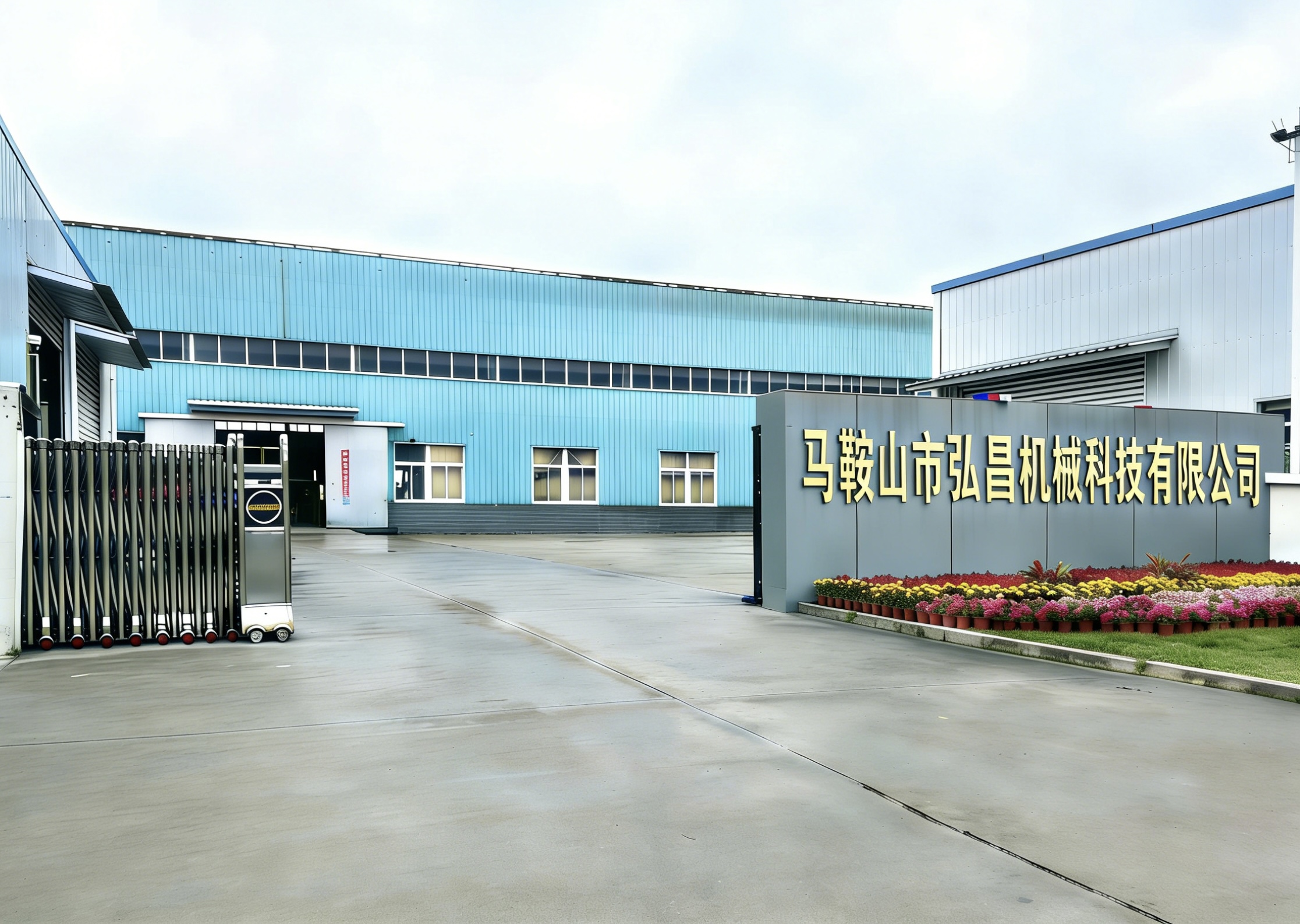
For a quotation, sample order, or technical review of your project specification, contact Hongchang Machinery Technology Co., Ltd. Chen Zhen — Tel/WhatsApp: +86-13301770177 — Email: chenzhen@hongchangpumpipe.com — Website: https://www.hongchangpumpipe.com
Have Questions or Need More Details?
Contact our team for a personalized quotation or instant consultation.
Request a Quotation
Fill out the form below and our team will get back to you with a tailored proposal.
WhatsApp Direct Chat
Prefer to chat in real-time? Message us on WhatsApp for instant assistance & quick answers.
- Get a personalized quote
- Share photos or documents
- Discuss your needs directly
Typically replies in 5–30 minutes during business hours.