Single-Layer vs Double-Layer Concrete Pump Elbows: A Duty-Matched Spec Guide
Single-Layer vs Double-Layer Concrete Pump Elbows: A Duty-Matched Spec Guide
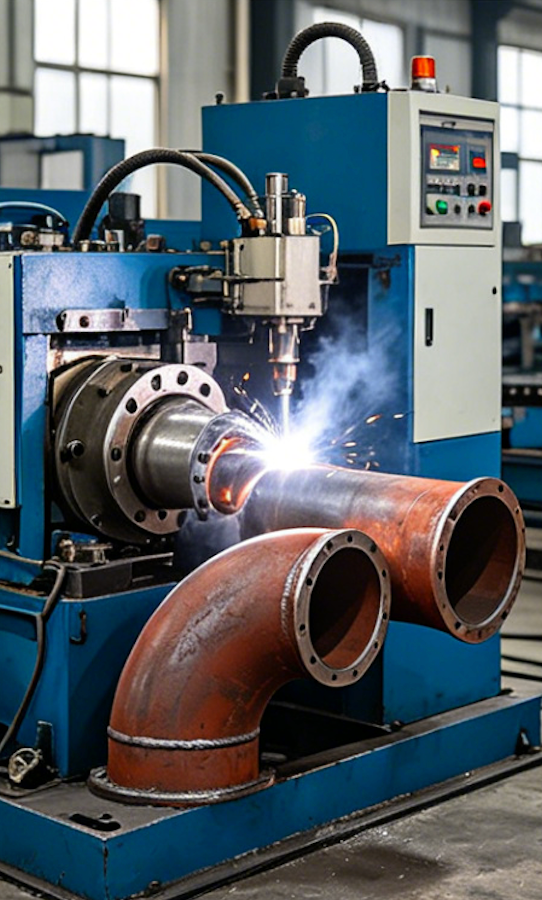
Automatic pipe bending welding machine — elbow forming at the front end of the delivery line.
The spec that wins is the one that matches the bend, not the one printed on the box.
Choosing between a single-layer and a double-layer concrete pump elbow is a line-design decision, not a supplier preference. A delivery line almost never wears out evenly. The straight runs erode slowly and predictably, while the bends absorb the impact of every aggregate particle that is forced to change direction. Two lines of identical total length can therefore produce completely different maintenance intervals.
The short answer: single-layer quenched alloy-steel pipe — such as Hongchang's 150L=3000 straight pipe (DN150, L=3000 mm, bore quenched to HRC 55–62) — is the economical spec for long straight runs. Double-layer elbows — such as the 150R400*90° DN150 elbow or the 275*90° double-layer elbow, both built with a quenched inner wall inside a heat-treated outer body — are the parts that decide how often a high-duty line is taken out of service. For high-rise pumping at 8–12 hours a day, tunnel work and underground mining, the wear budget belongs in the bends.
Hongchang Machinery Technology Co., Ltd. is a concrete pump pipe and elbow manufacturer based in Ma'anshan City, Anhui Province, China, producing concrete pump pipes, elbows, clamps and reducers, with roughly half of its output exported to Southeast Asia, the Middle East, Europe and the Americas. The specifications cited below are the published product data used to build the decision framework in this guide.
Problem Definition: Why the Bend, Not the Straight Run, Sets Your Replacement Interval
In a straight pipe, abrasive wear is distributed along the bore and the wear rate stays comparatively stable. In an elbow, three things happen simultaneously: the flow direction changes, the aggregate strikes the outer wall at an angle, and local turbulence and pressure loss increase. Wear concentrates on one side of the bend, and frequently on one elbow while the rest of the line is still serviceable.
That geometry is the reason there is no universal winner. The useful comparison is not pipe against pipe; it is position against duty:
- Position in the line: long horizontal and vertical straight runs behave very differently from the first bend after the pump outlet, the riser base, or the boom elbows.
- Duty profile: intermittent ground-pump work is not the same as continuous high-rise pumping at 8–12 hours a day, tunnel headings, or mining backfill.
- Replacement strategy: whether the site swaps single components between pours or rebuilds whole line sections during planned shutdowns.
Answer those three questions for your project and the single-layer versus double-layer debate resolves itself quickly for every position in the line.
Industry Background: Higher Pressures, Longer Lines, Tighter Scrutiny
Concrete pumping is a growing but performance-driven market. Credence Research valued the global concrete pump market at approximately USD 6.05 billion in 2024 and expects growth at a CAGR of 5.13% through 2032. A 2025 industry analysis of the concrete pump market estimates that Asia Pacific accounts for roughly a 42% revenue share, driven primarily by infrastructure projects in China and India, while a Technavio market analysis places truck-mounted concrete pumps at a 48% market share in 2025 because of their mobility in urban construction environments.
Two technical trends push in the same direction. First, delivery pressures keep rising: published technical documentation for twin-pipe (double-layer) delivery pipes describes designs rated for pressures up to 85 bar, aimed specifically at limiting abrasive wear from large aggregates. Second, compliance expectations are tightening — concrete conveying, spraying and placing machines fall within the scope of EN 12001:2012, which specifies safety requirements for that equipment class.
For a buyer, the practical consequence is straightforward: as pressure and aggregate size increase, the wear allowance engineered into the bends matters more than the nominal grade stamped on the pipe.
How the Two Constructions Differ
Single-layer wear-resistant construction: one wall doing two jobs
The 150L=3000 concrete pump straight pipe is a single-layer, wear-resistant straight pipe with a DN150 nominal bore and a 3,000 mm length. It is manufactured from 20# steel or quality alloy structural steel, with the bore quenched to a hardness of HRC 55–62. Hongchang publishes the design life in three tiers — 7,000–8,000 m³, 25,000–40,000 m³ and 40,000–50,000 m³ — with corresponding cost-performance indices of 1, 1.6 and 3.0.
In this construction, a single wall carries both the structural load and the abrasion. The hardened bore is the entire wear defence. There is no bond line or material interface to manage, inspection is simple, and the pipe serves the long, straight, evenly wearing sections of a line at an economical cost per meter.
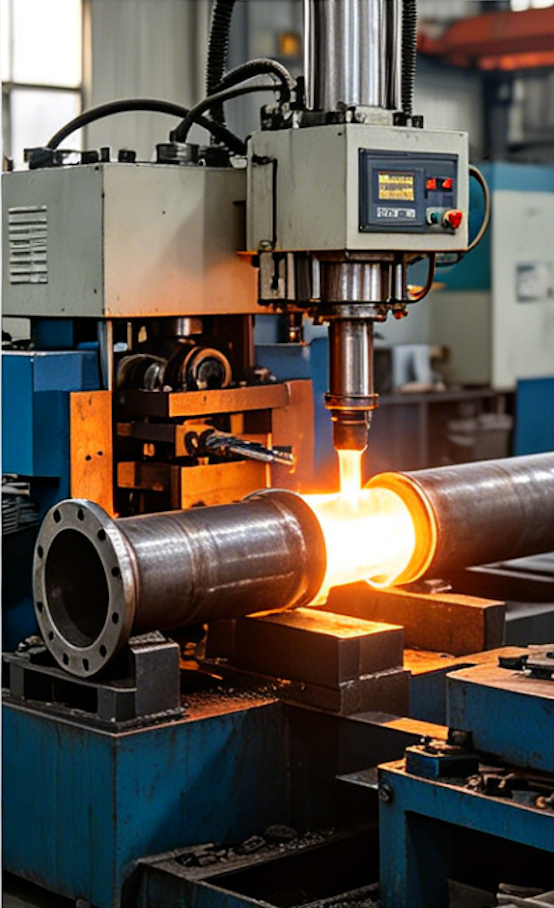
Numerical control high-frequency heat treatment machine — the quenching stage behind HRC 55–62 bores.
Double-layer construction: a hardened inner wall inside a tough outer body
The 150R400*90° is a double-layer elbow with a DN150 scope and R=400 geometry. Depending on the model, it is produced from wear-resistant cast steel or high-strength carbon steel by integral casting or welded forming, followed by heat treatment and quenching of the inner wall. The elbow is available in 90°, 45°, 30° and 15° configurations, with customizable bending radii including R180, R190.5 and R275.
The 275*90° double-layer elbow applies the same principle across a wider size range. It is offered in DN100, DN125 and DN150 nominal diameters, in the same four angle options with the same customizable R180 / R190.5 / R275 bend radii, and it is finished with an anti-rust primer and topcoat. Its defining feature is the quenched inner wall.
What the second layer buys is a division of labour: the abrasive workload is carried by a hardened inner surface, while the heat-treated outer body handles structural and pressure duty. In a bend — where the aggregate strikes one side of the bore — that separation is exactly what extends the service interval. It also gives the buyer a second lever: the bend radius. A longer radius such as R275 reduces the aggregate impact angle compared with a tighter R180 bend, at the cost of more space in the line layout.
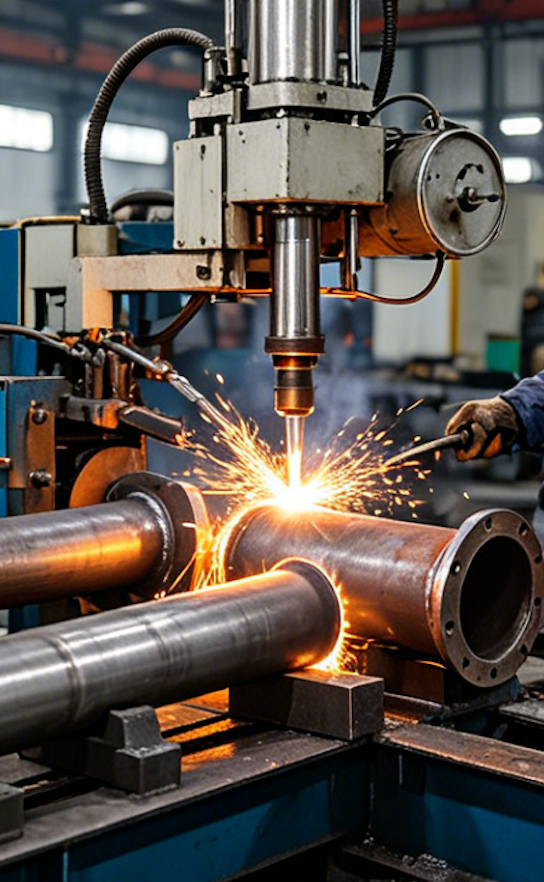
Automatic double-arm welding machine — welded forming for double-layer elbow bodies.
What the comparison actually turns on
Stripped of marketing language, single-layer versus double-layer comes down to three variables: how abrasive the mix is, how much pressure the line runs at, and how expensive it is to stop the pour. Where all three are moderate, a quenched single-layer pipe does the job. Where any one of them is high, the double-layer bend is the component that protects the schedule.
| Comparison dimension | Single-layer wear-resistant straight pipe (150L=3000) | Double-layer elbow (150R400*90° / 275*90°) |
|---|---|---|
| Structure | Single layer | Two layers: quenched inner wall plus heat-treated outer body |
| Material | 20# steel or quality alloy structural steel | Wear-resistant cast steel / high-strength carbon steel (150R400*90°); quenched inner wall (275*90°) |
| Hardening process | Quenching, bore hardness HRC 55–62 | Integral casting or welded forming + heat treatment + inner wall quenching |
| Geometry options | DN150, L=3000 mm | 150R400*90°: DN150, R=400; 275*90°: DN100 / DN125 / DN150. Both: 90° / 45° / 30° / 15°, radii R180 / R190.5 / R275 (customizable) |
| Published design life | 7,000–8,000 m³ / 25,000–40,000 m³ / 40,000–50,000 m³ in three tiers | Not published as a single figure — service interval depends on position and duty |
| Published cost-performance index | 1 / 1.6 / 3.0 across the three tiers | Not published as an index |
| Typical position in the line | Long horizontal and vertical straight runs | Bends, riser base, boom elbows and other high-impact positions |
| Surface treatment | Not specified in the published specification | 275*90°: anti-rust primer plus topcoat |
Concrete pump pipe production floor — annual output of 50,000 meters of straight pipe and 15,000 curved pieces.
Step-by-Step: Specifying the Right Combination in Six Steps
- Map the line. Count every elbow and label its position: pump outlet, first bend after the outlet, riser base, boom elbows, and the final bend before the placing point. On most lines, a small group of bends causes the majority of wear-driven downtime.
- Profile the duty. Record hours pumped per day, typical and maximum aggregate size, discharge pressure, and whether the line is a ground pump, a vehicle-mounted boom, or a stationary long-distance run.
- Assign a construction per position. Long straight runs are matched to quenched single-layer pipe; high-impact bends are matched to double-layer elbows. Keep one nominal diameter and one connection type through the line.
- Fix the geometry. Decide diameter, angle (90° / 45° / 30° / 15°) and bend radius. Where layout space allows, a longer radius reduces impact wear on the outer wall.
- Verify compliance and documentation. Confirm ISO 9001:2015 certification, its scope and its validity dates, and check how the delivery line will be documented against EN 12001:2012 if the project is in the EU.
- Validate by sample, then scale. Order the actual production specification in sample quantity, check bore hardness and dimensions, and only then move to volume supply or an OEM/ODM arrangement.
Application Decision Matrix: High-Rise, Tunnel, Mining and OEM
The matrix below translates the two constructions into real operating conditions. Read it as a starting configuration, then confirm with a sample from the exact production spec.
| Application | Duty profile | Spec to lead with | Basis |
|---|---|---|---|
| High-rise pumping | 8–12 hrs/day, long vertical riser, continuous pour cycles | Double-layer elbows at bend positions plus quenched single-layer straight pipe (150L=3000) on the runs | Construction company case: 50 units over 3 years, HRC 58–62, 30% longer lifespan than standard pipes, stable operation |
| Tunnel heavy duty | Sustained pressure, abrasive mix, many bends, difficult servicing | Double-layer elbows, longer radius preferred where space allows | Verified radius options R180 / R190.5 / R275 on both double-layer models; published twin-pipe designs rated up to 85 bar |
| Underground mining and backfill | Heavy duty, abrasive, high cost of unplanned downtime | Heavy-duty wear-resistant construction across the line | Mining company case: 100 meters installed, 4-year project, 40% reduction in maintenance |
| Pump truck manufacturing (OEM) | Repeatable fit, quality consistency, volume build | Double-layer elbows integrated at boom and outrigger bends | OEM case: 200 pieces over 2 years, successful OEM integration, delivered to 30+ countries |
| Mortar and ground pump lines | Lower pressure, finer material | Quenched single-layer straight pipe is usually adequate; reserve double-layer bends for mixed-duty sites | Duty-based reasoning: finer mixes are typically less abrasive than large-aggregate concrete |
High-rise pumping at 8–12 hours a day
Continuous pumping up a tall riser means the same bends take abrasion hour after hour. The verified reference is a construction company project in which 50 units were installed over three years: pipes reached HRC 58–62 hardness and delivered a 30% longer lifespan than standard pipes with stable operation, used by construction company clients across projects in Europe, Asia, the Middle East and the Americas. The usual configuration is double-layer elbows at the riser base and boom, with quenched single-layer straight pipe on the long vertical runs.
Tunnel heavy duty
Tunnel lines combine sustained pressure, abrasive mixes and a high number of bends, and they are difficult to service mid-shift. That is where the geometry lever matters most: selecting R275 or R190.5 bends rather than tighter radii where the layout allows, and keeping double-layer elbows on the first bends after the pump. The supporting product facts are the verified angle and radius options on both double-layer elbow models and the published twin-pipe pressure capability of up to 85 bar.
Underground mining and backfill
A mining company client installed 100 meters of concrete pump pipe for underground mining using the heavy-duty, wear-resistant design. Across a four-year project the installation achieved a 40% reduction in maintenance, addressing the frequent-maintenance problem typical of underground operations. The project covered mining operations in multiple countries, including the UAE, Afghanistan, Argentina and Australia.
Pump truck manufacturing and OEM integration
Equipment OEMs need repeatable fit and quality consistency more than they need the hardest bore in the catalogue. One OEM project supplied 200 pieces for pump truck manufacturing over a two-year period with custom specifications and quality consistency, achieving successful OEM integration across more than 30 countries including Germany, France, the UK, Canada and Australia. Hongchang is a designated supporting manufacturer for Xingma Automobile and states that its pipes can be matched to pump trucks and tow pumps from Sany Heavy Industry and Zhonglian Heavy Industry; Sany Heavy Industry is identified as the world's largest concrete pump equipment manufacturer by volume as of 2024.
Cost Logic: Cheapest Per Meter Is Not Cheapest Per Cubic Meter
The published cost-performance index covers the straight pipe range only: index 1 for a 7,000–8,000 m³ design life, 1.6 for 25,000–40,000 m³, and 3.0 for 40,000–50,000 m³. No equivalent published index exists for elbows, which is precisely why bend selection should be driven by position rather than by unit price.
The workable rule is to put the wear budget where the wear happens. Fitting double-layer elbows to every bend of a low-duty line adds weight and cost without changing the maintenance interval; fitting the cheapest bend at the first elbow after the pump outlet simply moves the failure earlier in the schedule.
Limits and Trade-offs Buyers Should Verify
- The published design-life tiers of 7,000–8,000 m³, 25,000–40,000 m³ and 40,000–50,000 m³ apply to the 150L=3000 straight pipe. They should not be read as a universal guarantee for elbows or for other diameters.
- Double-layer construction adds material and weight. On lines where layout space is tight, a longer radius such as R275 — which improves wear behaviour — may not physically fit.
- Real service life depends on aggregate type and size, pumping pressure, hours per day, bend radius, line alignment and clamp condition. Two sites using the same elbow can see different replacement intervals.
- Hardness is a wear indicator, not a complete specification. Bore hardness, wall thickness, dimensional accuracy and connection quality need to be verified together before a line is approved.
Frequently Asked Questions
What certification should a double-layer concrete pump elbow carry for a European project?
At minimum, ISO 9001:2015 quality management certification covering manufacturing quality. Hongchang's certificate is registered under number ISO-2024-HC, issued on 2025-11-13 and valid until 2028-11-12, with the scope stated as manufacturing quality. Beyond supplier certification, concrete conveying, spraying and placing machines fall within the scope of EN 12001:2012, which specifies safety requirements for that equipment class, so buyers should confirm how the delivery-line components will be documented against that standard for the specific project.
Can double-layer elbows be customized in angle, bend radius and diameter?
Yes. Both double-layer elbow models are offered in 90°, 45°, 30° and 15° configurations with customizable bending radii of R180, R190.5 and R275. The 150R400*90° is a DN150 double-layer elbow with an R=400 scope, and the 275*90° double-layer elbow is available in DN100, DN125 and DN150 nominal diameters with an anti-rust primer and topcoat finish. Hongchang also supplies on an OEM/ODM basis with custom specifications, logo printing, brand packaging and custom lengths.
Which spec gives the lower cost per cubic meter pumped?
There is no universal answer, because the published cost-performance index of 1 / 1.6 / 3.0 applies to the three design-life tiers of the 150L=3000 straight pipe — 7,000–8,000 m³, 25,000–40,000 m³ and 40,000–50,000 m³. No equivalent published index exists for elbows, so bend selection should be evaluated by position and duty instead. The practical rule is to spend the double-layer budget on the bends that fail first and to keep quenched single-layer pipe on the long, evenly wearing runs.
Can I test a sample before placing a volume order?
Yes. The minimum order quantity is 1 piece for a sample order, with a lead time of 15–30 days. Quality control covers 100% inspection, pressure testing, hardness testing (HRC) and dimensional checks, so the sample can be evaluated for bore hardness, dimensions and fit before volume supply is agreed. Monthly capacity is 50,000 meters of straight pipe plus 15,000 curved pieces, which supports scale-up after validation.
What is the lead time, and what support comes after delivery?
Standard lead time is 15–30 days, and after-sales support includes technical support, spare parts supply, installation guidance and remote troubleshooting. To start a comparison with your own line list, contact Chen Zhen at chenzhen@hongchangpumpipe.com or WhatsApp +86-13301770177 — Hongchang can quote from the positions and duty profile you supply, or send a sample for on-site evaluation first.
Conclusion: Match the Spec to the Position, Then Prove It
Single-layer and double-layer concrete pump elbows are not competing answers to the same question. The single-layer quenched straight pipe — the 150L=3000, DN150, HRC 55–62, with published design-life tiers and cost-performance indices — is the economical answer for long runs. The double-layer elbow — the 150R400*90° and the 275*90°, both with a quenched inner wall inside a heat-treated body and customizable angles and radii — is the answer for the bends that decide how often the line stops. High-rise pumping at 8–12 hours a day, tunnel heavy duty and underground mining all point to putting the wear allowance at the bend; ground pump and mortar lines usually do not need it.
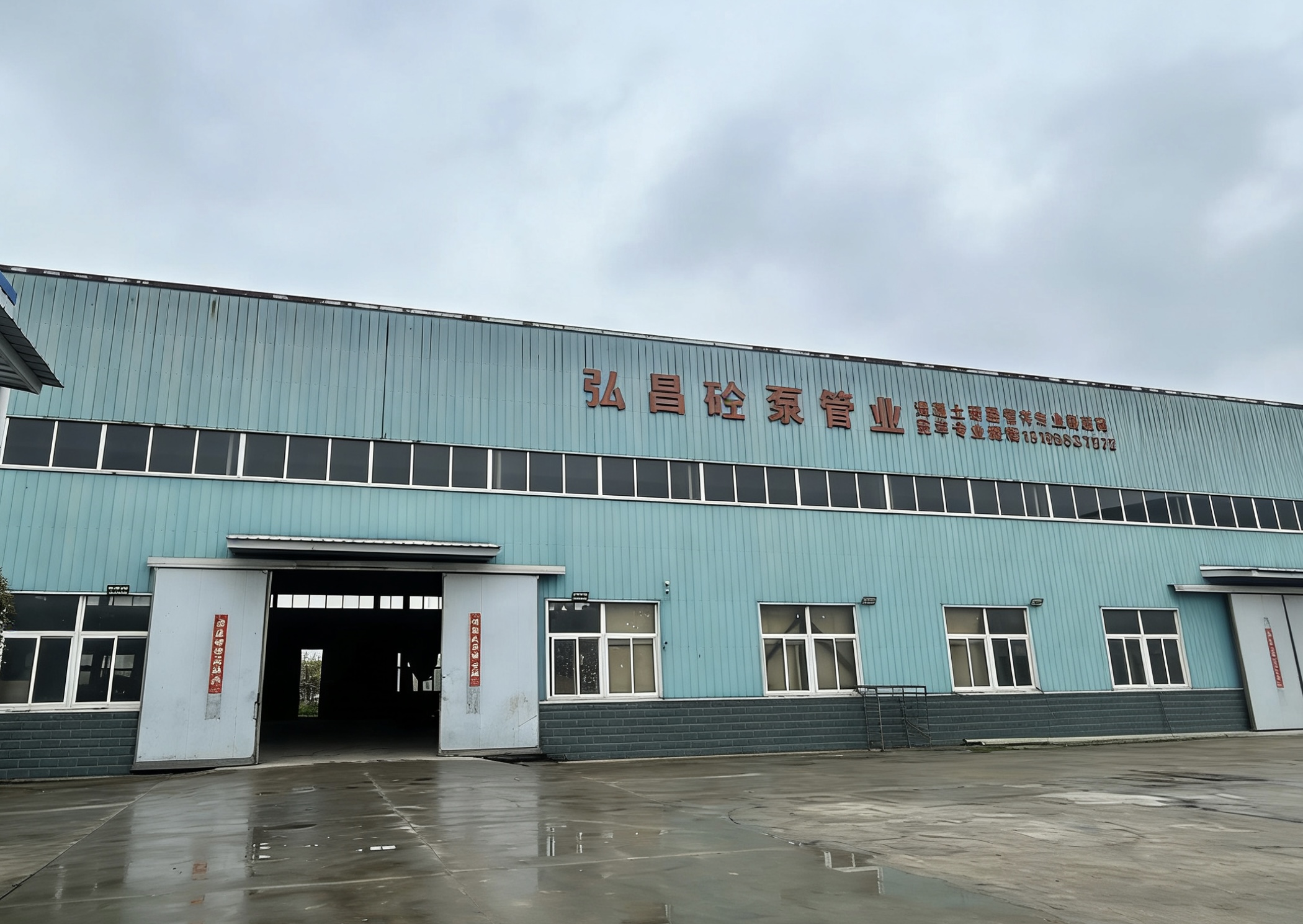
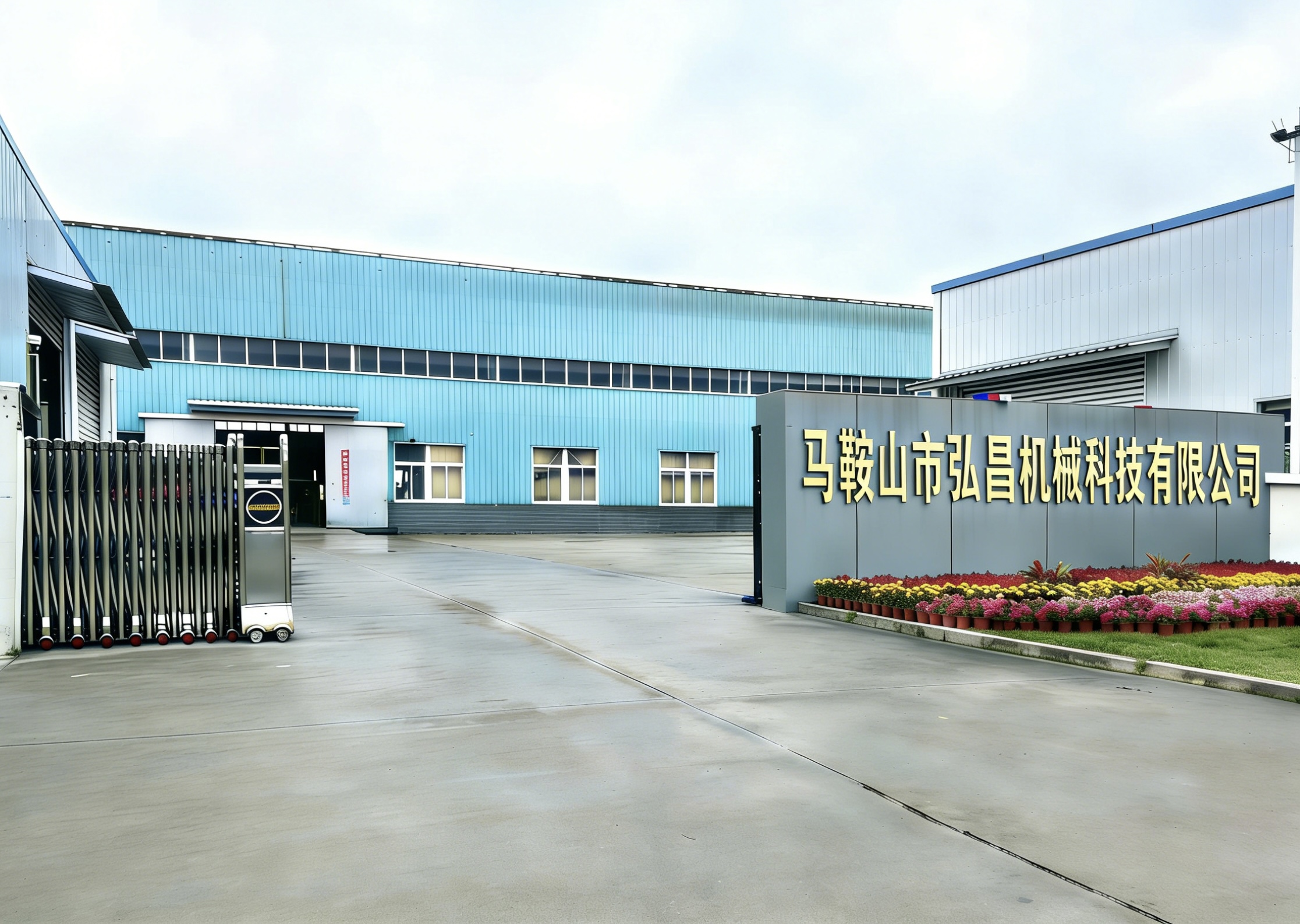
Hongchang Machinery Technology Co., Ltd., Ma'anshan City, Anhui Province, China.
Next Step: Send Us Your Line List
Hongchang Machinery Technology Co., Ltd. produces concrete pump pipes, elbows, clamps and reducers with an annual output of 50,000 meters of straight pipe and 15,000 curved pieces, exporting to Southeast Asia, the Middle East, Europe and the Americas.
Sample orders start at 1 piece with a 15–30 day lead time. Share your positions, diameter and duty profile and we will return a spec recommendation and a quote.
Contact: Chen Zhen — Email chenzhen@hongchangpumpipe.com — Tel/WhatsApp +86-13301770177 — No. 2063, Hongqi South Road, Development Zone, Ma'anshan City, Anhui Province.
Product and company information: hongchangpumpipe.com
Have Questions or Need More Details?
Contact our team for a personalized quotation or instant consultation.
Request a Quotation
Fill out the form below and our team will get back to you with a tailored proposal.
WhatsApp Direct Chat
Prefer to chat in real-time? Message us on WhatsApp for instant assistance & quick answers.
- Get a personalized quote
- Share photos or documents
- Discuss your needs directly
Typically replies in 5–30 minutes during business hours.