Concrete Pump Pipe Parameters: Diameter, Radius & Hardness
Concrete Pump Pipe Parameters: Diameter, Radius & Hardness
Concrete pump pipes are selected by three measurable parameters, and almost every delivery-line problem can be traced back to one of them: nominal diameter, bend radius, and inner-wall hardness. Diameter determines what the pump can move and how much pressure the line consumes. Radius determines where abrasion concentrates. Hardness determines how long the pipe survives that abrasion.
This technical guide is written for procurement engineers and technical buyers who are past general supplier discovery and are now evaluating rigid delivery-line components value by value. It covers the diameter range DN100–DN150, the bend radii R180, R190.5, R275 and R400, bend angles of 15°, 30°, 45° and 90°, the quenched inner-wall hardness of HRC 55–62 on 20# steel straight pipe, and the role of reducer pipes such as the 150-125 L=1200 in mixed-diameter systems. Specification data referenced throughout comes from the product range of Hongchang Machinery Technology Co., Ltd. — a concrete pump pipe manufacturer based in Ma'anshan City, Anhui Province, China, producing straight pipes, elbows, clamps and reducers, with roughly 50% of output exported to Southeast Asia, the Middle East, Europe and the Americas.
Scope note: this guide covers rigid components — straight pipe, elbows, reducers and clamps. Flexible end hose used at the placing point is specified separately and is outside the parameter set discussed here.
Why Parameter Mismatch, Not Pipe Price, Drives Delivery-Line Cost
The pipe is rarely the most expensive item in a concrete placing operation. The cost of stopping it is. A delivery line that wears through mid-pour forces an unplanned replacement, a cleared line, a cleaned pump and a crew standing idle — and three parameter-level mistakes produce most of those events.
- Diameter mismatch. A trunk line sized below what the pump outlet and the placing rate require makes the machine work at higher pressure for the same output. On a long-distance conveying run or a high-rise riser, that penalty accumulates with every metre of pipe.
- Radius mismatch. A bend that is tighter than the route needs concentrates material flow onto a narrow band of the outer wall, so one elbow wears through while the rest of the line still has service life left in it.
- Hardness mismatch. A pipe whose inner wall is not hardened for the abrasion duty it faces becomes the item that sets the replacement interval for the whole line, whether or not the rest of the components are still serviceable.
Those three risks scale with duty, and duty varies sharply by project type. High-rise building concrete pumping runs continuously for 8–12 hours per day, is integrated with a pump truck, and demands high pressure and wear resistance. Tunnel construction is heavy-duty operation in which the line performs direction changes of 90° to 180° and abrasion resistance is the governing requirement. Mine concrete injection runs continuously on slurry transportation through a slurry pump system, with corrosion and wear resistance specified. A delivery line specified for one of these conditions does not automatically transfer to another.
Industry Background: The Delivery Line Inside a Growing Pump Market
Demand for delivery-line components follows the concrete pump market itself. Third-party market research places the global concrete pump market at approximately USD 6.05 billion in 2024, with growth of about 5.13% CAGR expected through 2032 (Credence Research). Published estimates vary with what is counted — one alternative source puts the 2023 base at USD 5.18 billion (SNS Insider), while another measures incremental rather than absolute growth (Technavio) — so the useful reading is directional: the installed base of pumping equipment keeps expanding.
Regionally, Asia Pacific accounted for an estimated 42% of concrete pump revenue share in 2025, driven mainly by infrastructure work in China and India. By equipment type, truck-mounted concrete pumps held a dominant 48% market share in 2025 on the strength of their mobility in urban construction. Both figures matter for pipe specification, because a large installed base of vehicle-mounted pumping equipment means recurring demand for elbows with defined radii and for joints that can be opened and refitted quickly on site.
On the regulatory side, delivery systems for concrete and mortar fall under EN 12001:2012, which specifies safety requirements for conveying, spraying and placing machines. That standard is a common reference point when European projects define documentation requirements for a machine and its delivery line.
At the component level, one design pattern is widely used to counter abrasive wear at pressure: twin-wall, double-layer pipe. Suppliers of double-layer pipe describe this construction as a way to handle pressures up to 85 bar while minimizing wear from large aggregates (Esser Twin Pipes). Hongchang applies the same principle in its double-layer elbow, the 275*90° model, which is built with a quenched inner wall, and applies inner-wall quenching to its cast steel elbow family as well.
The Core Parameters of a Concrete Pump Pipe
Nominal Diameter: DN100, DN125 and DN150
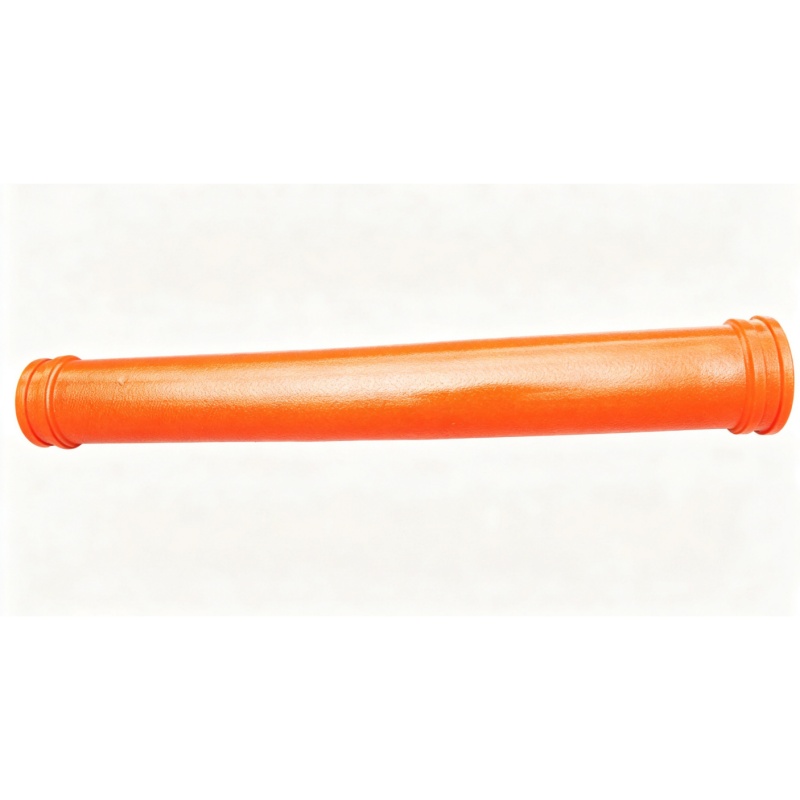
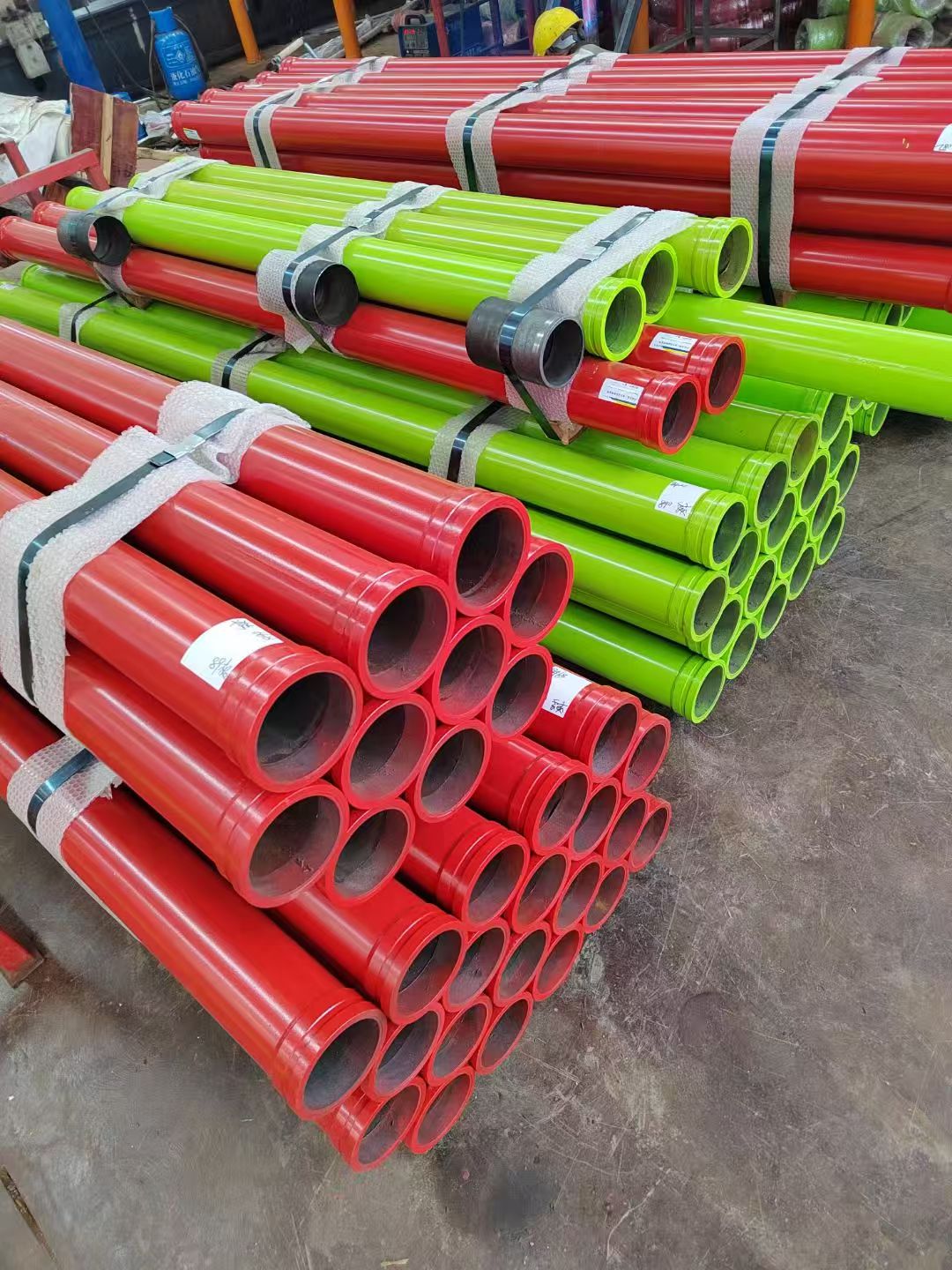
Nominal diameter describes the bore family of a component, not a single exact measurement. Within one delivery line, every rigid component must belong to the same DN family, or a reducer must step between two families. Hongchang elbows and clamps are produced for DN100, DN125 and DN150, with custom diameters available on request, and the straight pipe 150L=3000 is a DN150 section 3,000 mm long.
Three practical consequences follow from the diameter decision:
- Aggregate and mix pass-through. The bore has to suit the largest aggregate in the mix and the consistency of the mix itself. A large-diameter pump pipe line tolerates coarser, stiffer mixes than a narrow one, which matters on ground pump work where the mix is designed for a stationary machine rather than a boom line.
- Pressure consumption along the line. All else being equal, a smaller bore consumes more of the pump's available pressure over the same distance. On high-pressure conveying and long-distance conveying layouts, bore selection is therefore not a handling preference but a performance decision.
- Fleet and inventory discipline. Larger bore means heavier pipe and fittings. Standardizing a fleet on two diameters — typically DN150 for trunk runs and DN125 for terminal runs — reduces the chance of mismatched components arriving at site, and makes the reducer the single planned transition point.
Bend Radius and Angle: R180, R190.5, R275 and R400
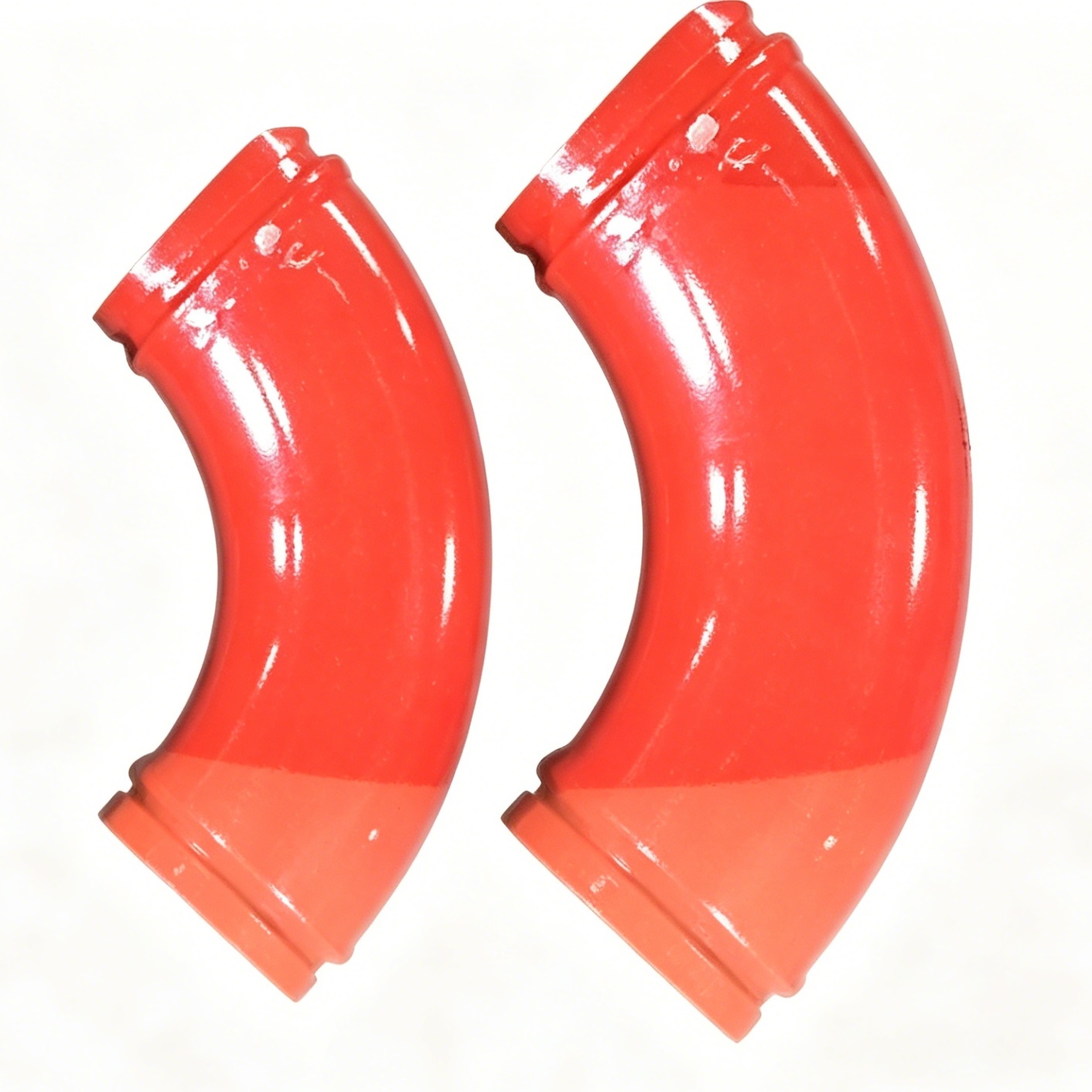
Radius describes how far from the pipe axis a turn is swept; angle describes how far the direction changes. Hongchang's double-layer and cast steel elbows are produced with bend radii of R180, R190.5 and R275, all customizable, and the cast steel elbow model 150R400*90° is specified at R=400 with a DN150 bore. Standard bend angles across the elbow range are 90°, 45°, 30° and 15°, and custom angles can be produced.
Radius matters more than it appears to. The abrasive stream in a bend strikes the outer wall at an impact angle set by the bend geometry. A longer sweep produces a shallower impact angle and spreads wear across a longer arc; a tight turn concentrates the same material flow onto a narrow band of wall. Radius also changes how much pressure the line consumes at that bend. This is why an otherwise identical delivery line can behave completely differently when one R180 elbow is substituted for an R400 elbow inside a high-volume run.
Angle works the same way in reverse. A single 90° elbow absorbs the full direction change in one component, whereas 15° or 30° elbows can be combined with others to build the same overall turn as a series of shallow deflections. Where the route allows it, that arrangement distributes wear across several components instead of concentrating it in one.
A practical rule for radius selection: match the radius to the adjacent component and to the route, not to a generic preference. R180, R190.5 and R275 exist because different pumping and boom configurations use different mating geometry; a radius that does not match the neighbouring section creates fit problems that no hardness advantage will compensate for. Where available space forces a tight turn, treat that elbow as a monitored wear item and inspect it on a defined interval.
Inner-Wall Hardness: HRC 55–62 After Quenching
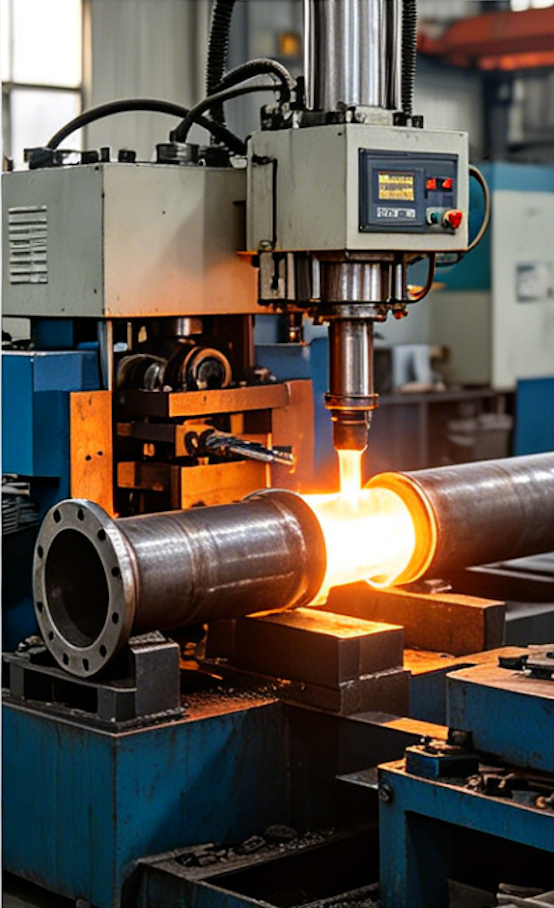
Hardness is the parameter that determines how long a pipe survives the abrasion its diameter and radius have allowed. Hongchang's wear-resistant straight pipe is produced from 20# steel or quality alloy structural steel as a single-layer pipe, with the inner wall quenched to a hardness of HRC 55–62. Independent press coverage of the manufacturer records the same figure: 50,000 meters of straight pipe and 15,000 curved pipes produced per year, with inner-wall hardness of HRC 55–62 achieved through quenching.
Quenching is applied to the inner wall because that is the surface in contact with the abrasive mix. The specification sheet for the same product family publishes design life in three tiers, together with a relative cost-performance index:
| Design life tier | Conveyed volume | Relative cost-performance index |
|---|---|---|
| Entry tier | 7,000–8,000 m³ | 1 |
| Mid tier | 25,000–40,000 m³ | 1.6 |
| Top tier | 40,000–50,000 m³ | 3.0 |
Read together, the two columns are the real purchasing argument. The top tier carries roughly three times the relative cost of the entry tier while covering several times the conveyed volume, which lowers the cost per cubic meter of concrete placed. Replacement labour and lost pumping time sit on the same side of that calculation, so the comparison worth running is cost per cubic meter conveyed — not price per metre of pipe.
For higher-pressure and heavier-abrasion duty, the double-layer elbow (275*90°) is built with a quenched inner wall, and the cast steel elbow family — 150R400*90° — is produced by integral casting or welded forming followed by heat treatment and inner-wall quenching. Field evidence points the same way: a construction company that received 50 units for a high-rise building project reported stable operation across three years and a lifespan 30% longer than the pipe it had been using, with a hardness highlight of HRC 58–62.
One limitation is worth stating plainly. Hardness is a target measured on the quenched inner wall, and it is not a stand-alone predictor of service life. Wall thickness, joint fit, pipe straightness, aggregate grading and the pressure the line actually runs at all influence wear. Hardness sets the ceiling; the rest of the specification determines whether the pipe reaches it.
Materials and Surface Treatment Across the Component Range
Each component in the line uses a material chosen for its job:
- Straight pipe (150L=3000): 20# steel or quality alloy structural steel, single layer, inner wall quenched to HRC 55–62.
- Double-layer elbow (275*90°): quenched inner wall, with anti-rust primer and topcoat spraying as surface treatment.
- Cast steel elbow (150R400*90°): wear-resistant cast steel or high-strength carbon steel, formed by integral casting or welded forming, then heat-treated with inner-wall quenching.
- Reducer pipe (150-125 L=1200): wear-resistant alloy steel or high-carbon steel pipe, surface treated by shot blasting, anti-rust primer and topcoat.
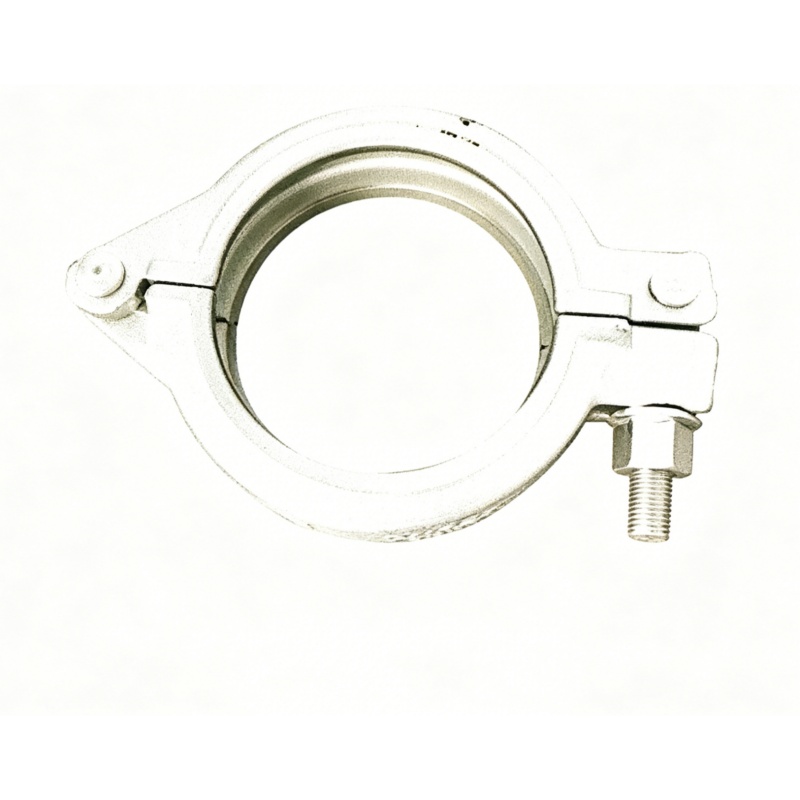
- Clamp (150A): high-quality cast iron or cast steel, integrally cast and precision machined, then shot blasted and anti-rust sprayed.
Surface treatment protects against corrosion during storage and site exposure; it is not a wear layer. Wear resistance in these components comes from the inner wall, which is why the material grade and the hardness specification belong in the same line item on a purchase order.
Reducer Pipes: Managing Diameter Transitions
Real delivery lines are rarely one diameter from pump to placing point. The reducer pipe 150-125 L=1200 steps a DN150 line down to DN125 over a 1,200 mm length, and it is the component that makes mixed-diameter systems workable. Connection options are a thickened pipe end, a flange, or a pipe clamp connection, and lengths are customized — 1 m, 1.5 m and 2 m are common alternatives.
The application this component was designed around is bridge construction and infrastructure work, where its role is precisely pipe diameter transition in a medium-pressure line, connected through matching fittings and requiring a precision fit. In practice the same component supports several situations: a pump outlet that is larger than the distribution line, a trunk line that narrows for the final approach to the placing point, or a fleet standardizing on DN125 terminal pipe while keeping DN150 main runs.
Two checks belong at goods-in: concentricity of the transition, and a clean internal finish. A poorly finished transition becomes a turbulence point as well as a wear point, and both effects shorten the life of the fittings around it.
Step-by-Step: Specifying a Delivery Line by Parameter
- Fix the diameter at the pump outlet. Record the outlet diameter and the pressure class of the machine. This sets the DN of the first pipe section and tells you immediately whether the line will need a reducer. Hongchang pipes are designed to be matched with any type of pump truck and tow pump, including equipment from Sany Heavy Industry and Zhonglian Heavy Industry, and the company is a designated supporting manufacturer for Xingma Automobile.
- Map the route and count the direction changes. Note every bend, the space available at each one, and whether it sits in a high-volume section of the line. Elbows in high-volume sections deserve the most conservative radius the route allows.
- Assign DN by section, not by preference. Keep one diameter through the trunk run, and place the transition at a single point — for example the 150-125 L=1200 for a DN150 to DN125 step. Stacking several transitions in one line adds turbulence and cost without adding capability.
- Choose the radius bend by bend. Use the longest sweep the route permits. Where space forces a tight turn, plan that elbow as a monitored wear item and keep a replacement within reach.
- Choose hardness by abrasion duty. Use the published design-life tiers as a decision table: an entry tier for light or intermittent duty, a mid tier for general construction site pumping, and the top tier for continuous high-pressure or abrasive work. Where pressure and abrasion combine, move to the double-layer construction.
- Specify joints and documentation. Clamps are available for DN100, DN125 and DN150. Production verification at Hongchang covers 100% inspection, pressure testing, hardness testing (HRC) and dimensional checks — request those records against the batch you receive.
Use Cases: How the Parameters Map to Project Conditions
High-rise conveying
Continuous 8–12 hour pumping days, integration with a pump truck, and a simultaneous demand for high pressure and wear resistance define this duty. In practice it is met with quenched straight pipe in the higher design-life tiers, a trunk run in DN150 or DN125, and elbows chosen for the riser transitions, where the longer R275 or R400 sweeps are preferred wherever the shaft geometry permits. A construction customer running 50 units on a high-rise building project reported stable operation over three years and a 30% longer lifespan than its previous pipe.
Tunnel construction
Tunnel work is heavy-duty operation, with the delivery line performing direction changes of 90° to 180° and abrasion resistance as the stated special requirement. That combination is elbow-intensive, and it is the case where cast steel elbows with heat treatment and inner-wall quenching (150R400*90°) earn their place alongside standard 90° and 45° angles, with 15° and 30° elbows used to build gradual turns where the tunnel profile allows them.
Mining and mine concrete injection
Mine concrete injection runs continuously — around the clock in the recorded scenario data — with slurry transportation through a slurry pump system, under corrosion and wear resistance requirements. A mining company that took 100 meters of pipe for underground mining reported four years of service with maintenance reduced by 40%.
Bridge and infrastructure works
In bridge construction the governing function of the reducer is pipe diameter transition at medium pressure, with connection fittings and precision fit as the special requirement — precisely the case the 150-125 L=1200 reducer is specified around.
OEM pump truck and ground pump lines
Equipment builders integrate pipe into new machines rather than replacing it on site, so fit and repeatability outrank price per piece. An equipment OEM that ordered 200 pieces for pump truck manufacturing reported successful integration after two years, citing custom specifications and quality consistency as the deciding factors.
Component Parameter Comparison
| Component | Model example | Diameter / scope | Key parameters | Material and process |
|---|---|---|---|---|
| Concrete Pump Straight Pipe | 150L=3000 | DN150, L=3,000 mm | Single layer; design life 7,000–8,000 / 25,000–40,000 / 40,000–50,000 m³; relative cost performance 1 / 1.6 / 3.0 | 20# steel or quality alloy structural steel; inner wall quenched HRC 55–62 |
| Concrete Pump Elbow | 150R400*90° | DN150, R=400 | Angles 90° / 45° / 30° / 15° (customizable); integral casting or welded forming + heat treatment + inner-wall quenching | Wear-resistant cast steel or high-strength carbon steel |
| Double-layer Elbow | 275*90° | DN100 / DN125 / DN150 | Angles 90° / 45° / 30° / 15° (customizable); bend radius R180 / R190.5 / R275 (customizable) | Quenched inner wall; anti-rust primer + topcoat spraying |
| Reducer Pipe | 150-125 L=1200 | DN150 → DN125, L=1,200 mm | Connection by thickened pipe end, flange or pipe clamp; lengths customized (common 1 m / 1.5 m / 2 m) | Wear-resistant alloy steel or high-carbon steel pipe; shot blasting + anti-rust primer + topcoat |
| Concrete Pump Clamp | 150A | Compatible with DN100 / DN125 / DN150 (customizable) | Integral casting + precision machining | High-quality cast iron or cast steel; shot blasting + anti-rust spraying |
One pattern is worth noting when the table is read across: hardness and design life appear only where the specification publishes them — the straight pipe. For elbows, reducers and clamps, the decisive parameters are geometry (diameter, radius, angle) and material, because those components are replaced when they wear out or no longer fit, not against a published conveyed-volume figure.
Frequently Asked Questions
What documentation and standards apply to a concrete pump pipe order?
Hongchang's production verification covers 100% inspection, pressure testing, hardness testing (HRC) and dimensional checks, and those batch records are the documents a buyer should request against the specification. For equipment that conveys, sprays or places concrete and mortar, the relevant European reference is EN 12001:2012, which specifies safety requirements for those machines. If a project requires CE-marked or ISO 9001-documented supply, confirm the certificate scope and the batch documentation at the quotation stage rather than assuming them from a product listing.
Which diameter, radius and angle combinations can be supplied together?
Elbows and clamps are produced for DN100, DN125 and DN150 nominal diameters, with custom diameters available. Standard bend radii are R180, R190.5 and R275, customizable on request, and the cast steel elbow 150R400*90° is specified at R=400 for a DN150 line. Standard angles are 90°, 45°, 30° and 15°, with custom angles available. Diameter transitions are handled by reducers such as the 150-125 L=1200, which steps DN150 down to DN125 over 1,200 mm and connects by thickened pipe end, flange or pipe clamp.
How should the hardness tiers be compared on price?
Compare cost per cubic meter conveyed, not price per meter of pipe. The published design-life tiers are 7,000–8,000 m³, 25,000–40,000 m³ and 40,000–50,000 m³, with relative cost-performance indices of 1, 1.6 and 3.0. The top tier carries roughly three times the relative cost of the entry tier while covering several times the conveyed volume, so the replacement labour and pumping downtime it avoids usually decide the comparison.
Can a sample or trial piece be ordered before specifying a full line?
Yes. The minimum order quantity is 1 piece as a sample order, and OEM/ODM work covers custom specifications, logo printing, brand packaging and custom lengths. A trial piece allows bore, wall hardness and joint fit to be checked against the specification sheet before a full delivery line is committed — the most reliable way to confirm that a quoted parameter such as HRC 55–62 matches the pipe that actually arrives.
What lead time and production capacity should be planned for?
Quoted lead time is 15–30 days. Monthly capacity is 50,000 meters of pipe plus 15,000 curved pieces, consistent with an annual output of 50,000 meters of straight pipe and 15,000 curved pipes. For a project-specific quotation, a technical clarification or a sample request, contact Hongchang Machinery Technology Co., Ltd. at chenzhen@hongchangpumpipe.com, on WhatsApp at +86-13301770177, or through hongchangpumpipe.com.
Conclusion: Three Parameters, One Decision Table
A concrete pump pipe line is specified in the right order when diameter is fixed by the pump outlet and the placing rate, radius is fixed by the route geometry and the space available at each bend, and hardness is fixed by the abrasion duty the line will actually see. DN100, DN125 and DN150 cover the standard bore range; R180, R190.5, R275 and R400 cover bend geometry; and an inner wall quenched to HRC 55–62 on 20# steel or quality alloy structural steel covers the wear requirement in most construction site pumping. Reducers such as the 150-125 L=1200 handle the transitions, and clamps hold the joints at the matching diameter.
Get those three right, and the remaining choices — angle mix, surface treatment, joint type — become details instead of risks.
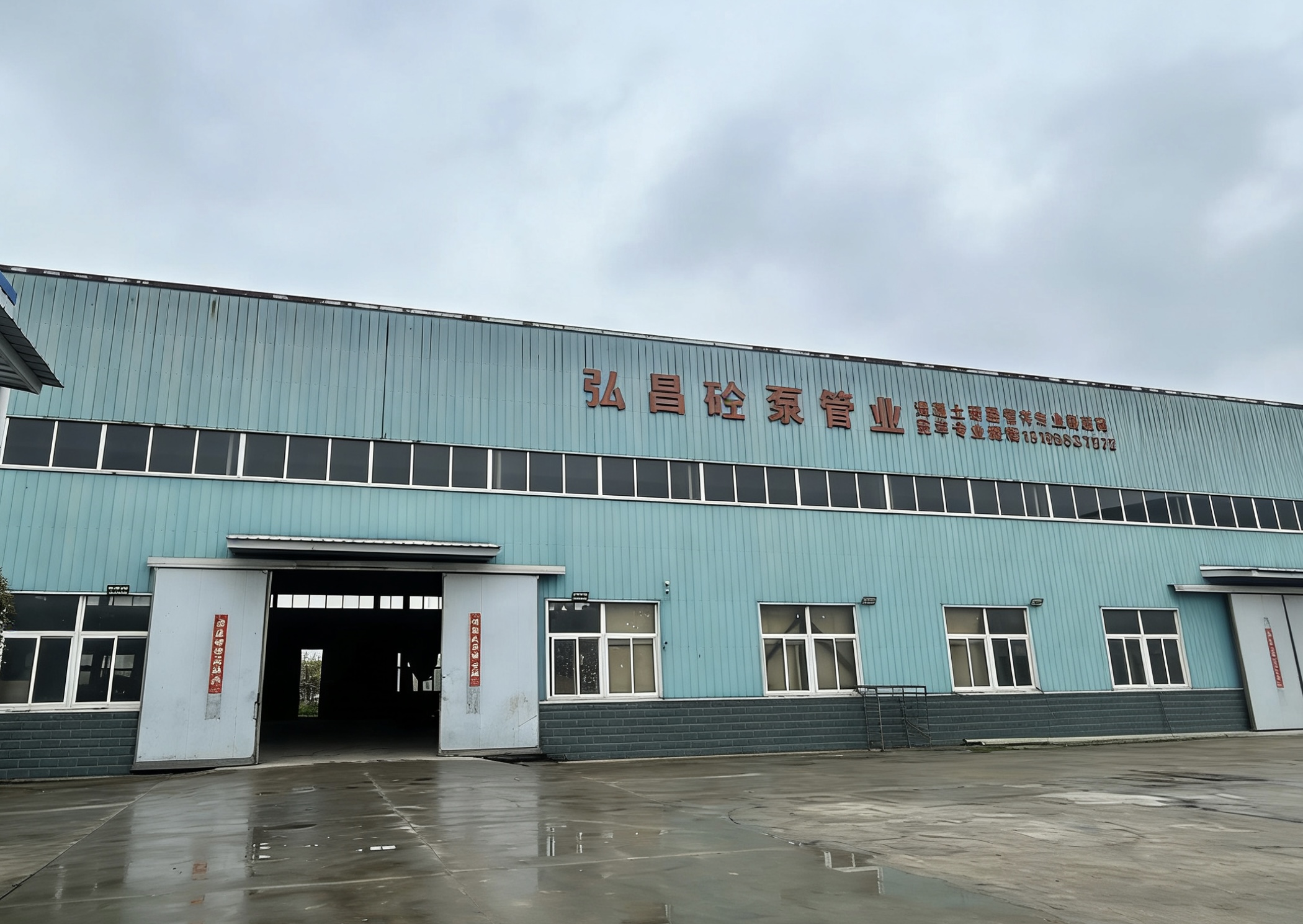
Next step: if you are finalising pipe specifications for an upcoming project, Hongchang Machinery Technology Co., Ltd. supplies concrete pump pipes, elbows, clamps and reducers with OEM/ODM customization, a 1-piece sample order, and a quoted lead time of 15–30 days.
Email: chenzhen@hongchangpumpipe.com | WhatsApp: +86-13301770177 | Website: https://www.hongchangpumpipe.com/
Have Questions or Need More Details?
Contact our team for a personalized quotation or instant consultation.
Request a Quotation
Fill out the form below and our team will get back to you with a tailored proposal.
WhatsApp Direct Chat
Prefer to chat in real-time? Message us on WhatsApp for instant assistance & quick answers.
- Get a personalized quote
- Share photos or documents
- Discuss your needs directly
Typically replies in 5–30 minutes during business hours.