Supplier Evaluation for Concrete Pump Pipes: Verifying Foundry, Quenching, and Delivery Capacity
Two concrete pump pipe suppliers quote the same DN125 straight pipe, the same 90° elbow and the same 150A clamp. The paperwork looks alike, the price gap is often around 15%, and the decision quietly falls back on price and promised delivery date — the only two variables a procurement team can check without standing on a factory floor.
The variables that actually decide how many cubic metres a line delivers before the worn section is cut out do not appear on a quotation: casting quality inside the elbow, heat-treatment control along the straight pipe, dimensional precision at the clamp joint. This article is an audit framework for closing that gap at the final decision stage, when the shortlist is already fixed and the remaining work is evidence rather than discovery.
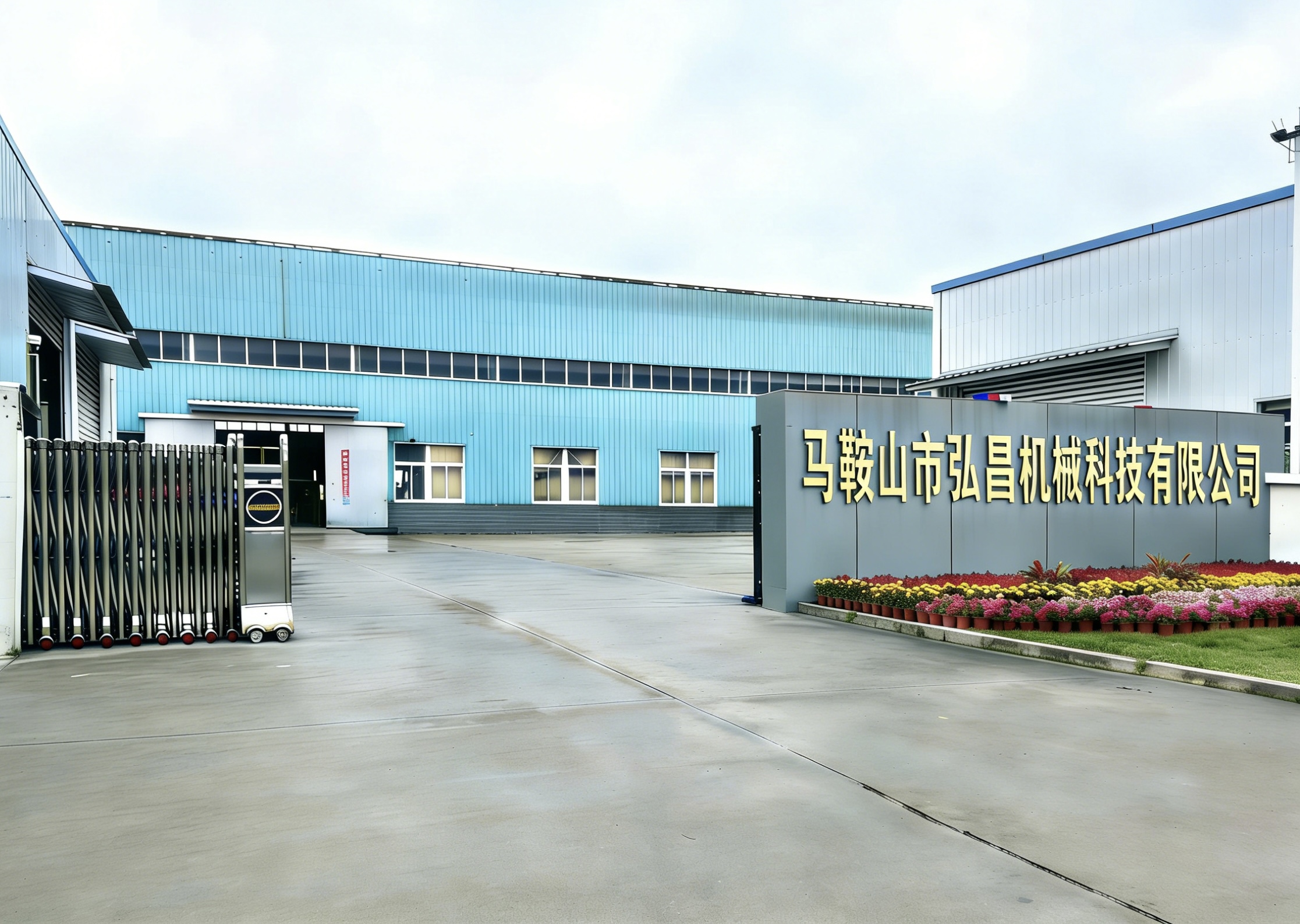
The reference case used throughout is Hongchang Machinery Technology Co., Ltd., a concrete pump pipe manufacturer based in Ma'anshan City, Anhui Province, China, producing straight pipes, elbows, clamps and reducers since 2015.
The Evaluation Problem: A Quotation Cannot Show a Process
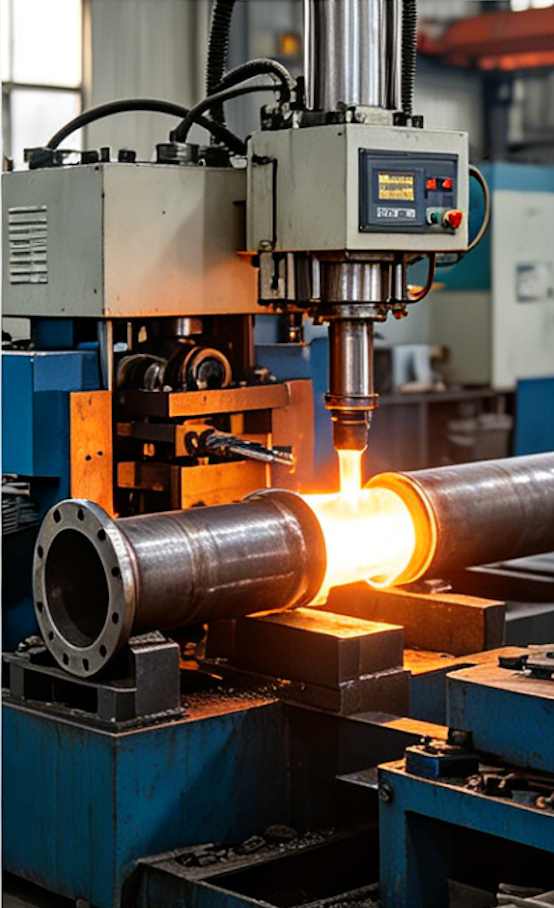
A concrete pump pipe quotation is a specification list. It states diameter, length, wall thickness, material grade and price. It does not state where the elbow was cast, how the straight pipe was quenched, how many hardness readings were taken, or which machine cut the clamp blank. Those are process facts, and process facts are what separate a wear part that reaches its expected service life from one that does not.
Three supplier claims are consistently hard to verify from documents alone:
- Casting and heat treatment of the elbow. A double-layer elbow is stated to be cast steel and heat-treated, but the casting source, the heat number and the post-cast heat-treatment record are rarely attached to a quotation.
- Hardness control on the straight pipe. A hardness figure on a datasheet can be a single sample value. A controlled production band is a different claim, and it requires instrument, location and sampling data.
- Delivery capacity. A promised lead time can reflect capacity, or it can reflect optimism. Capacity is verifiable through annual output, buffer stock policy and reference deliveries with a duration attached.
The cost of getting these three wrong is not abstract. A manufacturer that tracks its own risk register typically groups the exposure into four categories, and each category leaves a different evidence trail. Hongchang's documented risk controls illustrate the pattern a buyer should look for:
Material defects → controlled through supplier qualification and raw material testing, with a certificate of quality issued for each batch.
Product quality → controlled through ISO-based quality control and 100% inspection, with multiple QC checkpoints, pressure testing and hardness verification.
Delivery delay → controlled through production planning and safety stock, including 30% buffer stock for common sizes.
Technical support → controlled through 24/7 remote support, technical documentation, installation guidance and spare parts supply.
Each of those controls produces an artefact: a batch certificate, a hardness record, a pressure-test sheet, a stock policy, a support channel. A supplier evaluation is simply the disciplined request for those artefacts before the purchase order, not after the first complaint.
Industry Background: Why a Pipe Is a Wear Part, Not a Steel Tube
Concrete pump pipes sit inside a larger machine. Manufacturer technical material describes a trailer concrete pump as a system built from a pumping unit, a receiving hopper, a delivery valve, pumping cylinders and pistons, and a hydraulic system. The delivery line — straight pipes, elbows, reducers and clamps — is the part of that system in continuous abrasive contact with the mix, which makes it a consumable rather than a permanent component.
Demand for those consumables tracks pump population. Market research material estimates the global concrete pumps market at USD 10.45 billion in 2024, projected to reach USD 11.06 billion in 2025. Growth in the installed base does not by itself tell a buyer which pipe to approve, but it explains why so many suppliers describe the same product in the same language.
Three technical reference points frame any evaluation:
- Material norms. Secondary industry reporting describes ST52 steel at DN125 with a 4.5–5 mm wall as a common configuration for high-pressure delivery.
- Wear-life spread. The same secondary reporting puts twin-wall boom pipes at roughly 50,000–100,000 m³ of service life against 15,000–25,000 m³ for standard single-layer pipes. Treat these as directional ranges, not guarantees, because duty cycle and mix design move the number considerably.
- Standards scope. ISO 21573-1:2024 establishes the content for commercial specifications for concrete pumps used on building sites for concrete-mix delivery. It is a pump-level document. It is not a pipe-product certification, and no supplier should present it as one.
Customs treatment adds a documentation dimension. A US Customs ruling (HQ 966927) classifies steel pipes used in concrete pumping under HS 7304 for seamless pipe or 7306 for welded pipe when treated as piping, or under 8413.91 as parts of pumps for specific rulings. The correct heading depends on jurisdiction and on how the product is presented, so landed-cost comparison needs the supplier's classification paperwork, not an assumption.
The Capability Audit Framework: Four Production Stages and One Delivery Test
The framework below converts a general supplier questionnaire into four process-specific verifications plus one capacity verification. Each stage states what to verify, what the reference supplier documents, and what evidence to request in writing.
Stage 1 — Foundry and Casting Capability for Double-Layer Elbows
A double-layer elbow pairs an outer shell with a wear-resistant inner layer, and the elbow is the highest-wear item on most delivery lines because the change of direction concentrates abrasion. The audit question is not whether a supplier sells elbows; it is whether the casting source and the post-cast heat treatment are fixed, traceable and documented.
Verify: the identity and qualification of the casting source; the heat-treatment route applied to the cast body; a material certificate per heat number; hardness readings taken on the wear surface; bend radius and wall thickness against the drawing; and a batch mark that links the finished elbow back to the heat.
Hongchang's documented position: elbows are part of the product range alongside straight pipes, clamps and reducers; the company states independent design and development capability for pumps and pipes and a complete production management system; its documented equipment set includes a numerical control high-frequency heat treatment machine, an automatic pipe bending welding machine, a hydraulic sleeving machine, a double-arm sawing machine and an automatic double-arm welding machine. Quality control is described as multiple QC checkpoints with pressure testing and hardness verification, and a certificate of quality is issued for each batch.
A buyer should also ask which elbow families are cast and which are fabricated and welded. That answer determines which records matter: a heat certificate for a casting, or a welding procedure and weld inspection record for a fabricated bend.
Stage 2 — Quenching Control on Straight Pipes at HRC 55–62
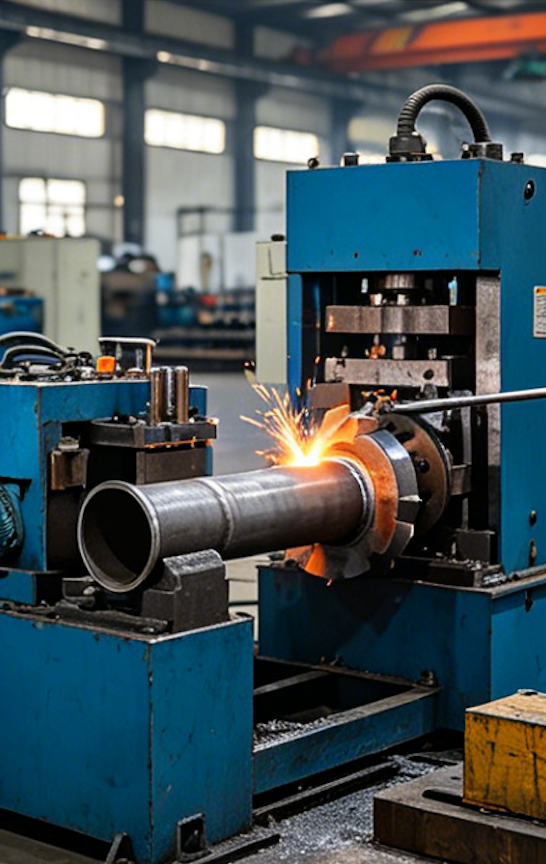
Hardness is the most quoted and least contextualised number in a pump pipe datasheet. For straight pipes supplied by Hongchang, the stated working range is HRC 55–62. The value of that band is not the number itself but what it implies: a repeatable quench and temper route, held inside a window, rather than a single favourable test result.
Verify: the hardness scale and instrument used; the location on the pipe where readings are taken; how many readings are recorded per batch or per length; what happens to material that falls outside the band; and whether hardening is applied to the full section or only to the wear surface.
Hongchang's recorded comparison against generic concrete pump pipes states 2–3 times longer service life and higher hardness, attributed to better heat treatment and a higher HRC. The same comparison records a 30% longer lifespan and a 20% lower wear rate. These are supplier-reported values and should be tested against the buyer's own duty cycle, but they define what the supplier is prepared to be measured on — which is exactly what a capability audit needs.
Audit rule: a hardness value without a sampling method is a marketing number. A hardness band with an instrument, a location and a per-batch record is a process control. Ask for the second, and ask for it for the last three batches, not the last one.
Stage 3 — Precision Machining for Clamps (150A, DN100–DN150)
Clamps rarely fail from abrasion; they fail from fit. A clamp that does not seat squarely produces misalignment at the joint, and misalignment creates a local disturbance in flow that accelerates wear on the adjacent pipe and elbow while inviting leakage. Machining precision is therefore a wear-life variable, not a cosmetic one.
Verify: dimensional inspection of the clamp body and coupling surfaces; bore and seat geometry against the mating pipe end; hardware specification; an interchangeability check against the buyer's existing line across the DN100–DN150 range with 150A connections; and a material certificate for the clamp body.
Hongchang lists clamps within its product range and describes 100% inspection as part of its quality control, supported by multiple QC checkpoints. For a first order, the practical request is a first-article inspection report for the specific clamp size in use, cross-checked against a sample fitted to a real pipe end rather than to a gauge alone.
Stage 4 — Reducer Fabrication (150-125, L=1200)
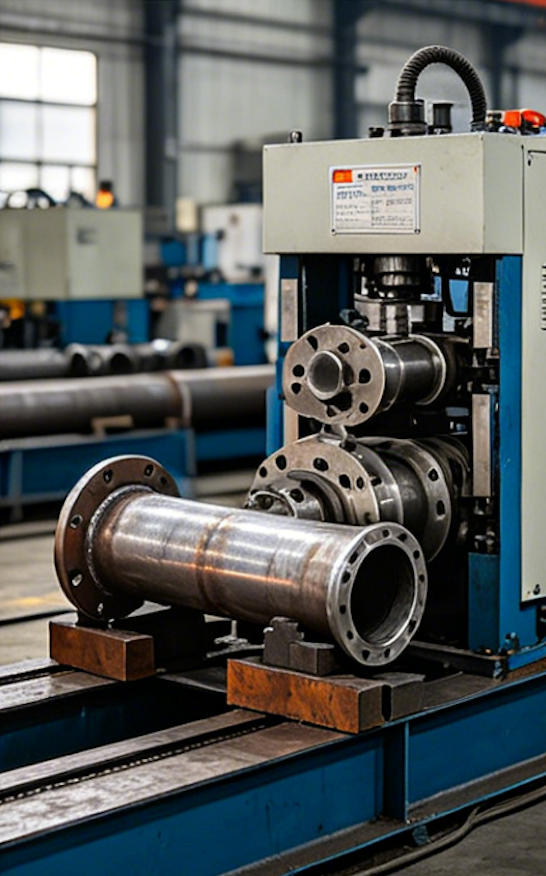
Reducers are the transition points where line diameter changes, and a 150-125 reducer with a 1200 mm overall length is a fabricated assembly rather than a simple cut length. The audit focus shifts from casting to welding and dimensional control.
Verify: the welding procedure and welder qualification behind the assembly; weld inspection method and results; concentricity between the two end diameters; overall length tolerance against the 1200 mm requirement; and pressure integrity at the specified test pressure.
Hongchang states pressure testing among its QC checkpoints and lists reducers within its product range, with an automatic double-arm welding machine in the documented equipment set. For a reducer order, the pressure-test record is the single most useful document to request, because it tests the assembly rather than the components.
Stage 5 — Delivery Capacity: Turning Capacity Into a Schedule
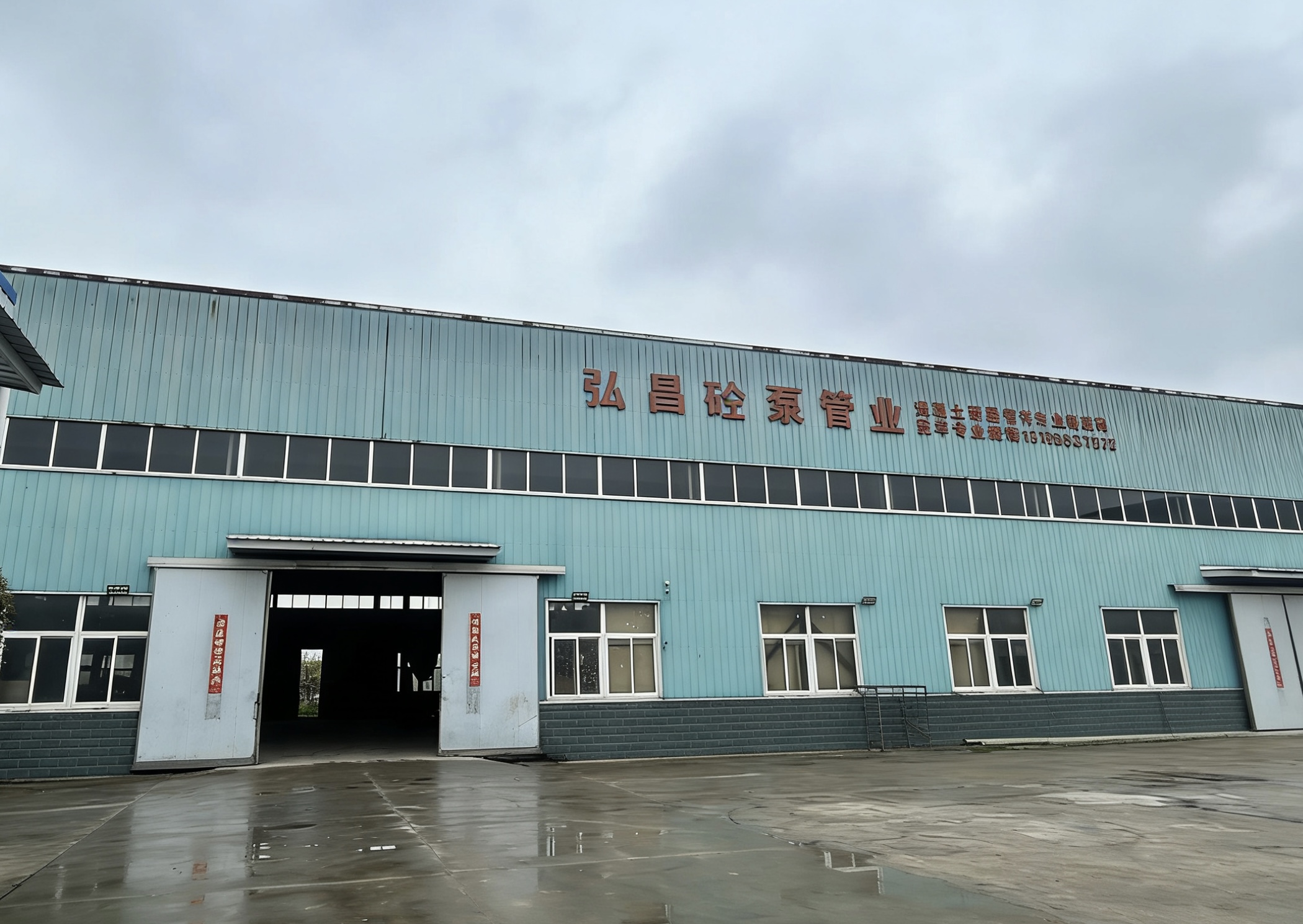
Capacity claims become meaningful only when they are converted into a schedule the buyer can hold the supplier to. Hongchang's stated manufacturing base is a 2,600 m² facility with 50+ employees and annual output of 50,000 meters of straight pipes plus 15,000 pieces of curved pipes. Roughly 50% of output is exported, with Southeast Asia, the Middle East, Europe and the Americas listed as main markets.
Three reference deliveries make the capacity concrete rather than theoretical:
- Pump truck manufacturing: 200 pieces supplied over a two-year period to a pump truck production line.
- High-rise projects: 50 units delivered across high-rise construction projects over three years.
- Underground mining: 100 meters supplied for underground mining duty, with a reported 40% improvement in wear life.
Read a reference delivery on three axes before accepting it: the customer type (OEM line, contractor, mining operator), the product mix actually shipped, and the duration. A two-year OEM supply relationship demonstrates repeatability and dimensional consistency; a three-year spread across high-rise projects demonstrates campaign supply into vertical work; a mining reference demonstrates wear performance under abrasive duty. None of the three proves the others.
Delivery control sits behind those references. Hongchang describes production planning plus safety stock, with 30% buffer stock held for common sizes — a policy that matters most on repeat orders for standard diameters, where a stock buffer can absorb a schedule shock that pure capacity cannot.
Step-by-Step Breakdown: A Six-Step Supplier Audit Sequence
The sequence matters. Auditing capacity before the duty definition is fixed produces a comparison of unrelated products, and auditing price before the process route is known produces a comparison of unrelated risks.
- Fix the duty definition. Write down the diameter range (for example DN100–DN150), the connection standard (150A clamps), the reducer specification (150-125, L=1200), the pump type the line serves, and the application. Hongchang states that its pipes can be matched with any type of pump truck and tow pump from Sany Heavy Industry and Zhonglian Heavy Industry, and that the company is a designated supporting manufacturer for Xingma Automobile — useful compatibility evidence, but it still has to be mapped to your specific machine.
- Map each part to a process route. For each item on the list, establish which stages are performed in-house and which are subcontracted: casting, heat treatment, welding, machining, inspection. Subcontracted stages are not disqualifying; undocumented subcontracted stages are.
- Request process records per stage. A heat certificate for cast elbows, hardness readings with instrument and location for straight pipes, weld inspection for reducers, dimensional reports for clamps. Records should cover several recent batches, not one selected sample.
- Verify batch traceability and inspection discipline. Ask how a finished pipe can be traced to its material batch, what the certificate of quality per batch contains, which checkpoints exist between forming and dispatch, and whether inspection is 100% or sampled. Hongchang describes ISO-based quality control with 100% inspection and multiple QC checkpoints including pressure testing and hardness verification.
- Convert capacity into a dated schedule. Take the annual output figure, the buffer stock policy and the reference deliveries, then ask for a written schedule for your specific mix. A supplier holding 30% buffer stock for common sizes should be able to state which of your items come from stock and which from production.
- Close the commercial case against wear life, not unit price. The recorded comparison places Hongchang's initial cost about 15% above generic concrete pump pipes, against 2–3 times the service life, reduced maintenance frequency and less downtime. The premium is fixed and known; the wear-life multiplier is the variable that must be validated on your duty.
Use Cases: Where the Audit Emphasis Changes
The same framework applies across applications, but the weight shifts. Four scenarios show how.
Pump truck manufacturing and OEM assembly
In an OEM line, the pipe becomes part of a new machine, so dimensional repeatability and interchangeability outrank wear claims. A 200-piece supply over two years is the relevant proof, because it demonstrates the supplier can hold tolerances across repeat batches rather than across a single shipment.
High-rise conveying
Vertical lines concentrate wear at the bends and load the joints, so casting quality in the elbow and quench control on the straight pipe dominate. The 50-unit supply across high-rise projects over three years is the reference to interrogate, along with the pressure-test records for the elbows in that configuration.
Underground mining and tunnel construction
Abrasive duty shortens every wear interval, so the wear-resistant grade and the joint integrity decide the replacement frequency. The 100-meter underground mining delivery with a reported 40% wear-life improvement is the most relevant reference for this duty, and the buyer should ask what the comparison baseline was.
Stationary ground pumps, trailer pumps and mortar lines
Fixed lines run long distances with fewer bends, so straight pipe hardness consistency and long-distance conveying behaviour become the primary variables, with clamp fit determining whether the line stays tight over a long run. Mortar conveying adds a finer, more penetrating mix, which makes joint sealing and wall thickness more relevant than bend geometry.
Comparison Table: Hongchang and Generic Concrete Pump Pipes
The table below reproduces the recorded comparison between Hongchang concrete pump pipes and generic concrete pump pipes. Every value is supplier-recorded and should be treated as a claim to be validated on site, not as an independent test result.
| Comparison metric | Generic concrete pump pipe | Hongchang concrete pump pipe |
|---|---|---|
| Service life | Baseline | 2–3 times longer |
| Hardness | Baseline | Higher hardness, attributed to better heat treatment |
| Recorded performance gap | — | 30% longer lifespan; 20% lower wear rate |
| Initial cost | Baseline | Approximately 15% higher |
| Maintenance profile | Baseline | Reduced maintenance frequency, less downtime |
| Process basis for the claim | Not specified | Heat treatment control; higher HRC hardness |
The table is deliberately short. Hardness and service life are the only dimensions on which the reference supplier records a direct comparison, and a longer table would require manufacturing performance data that neither party has published in comparable form.
Audit evidence map
| Stage | Record to request | What it actually proves |
|---|---|---|
| Double-layer elbow casting | Heat number, casting source, post-cast heat-treatment record, wear-surface hardness | The bend was made from traceable material and treated after casting |
| Straight pipe quenching | Hardness readings with instrument, location and per-batch sampling at HRC 55–62 | Hardness is controlled as a band, not reported as a single value |
| Clamp machining (150A, DN100–DN150) | First-article dimensional report plus a physical fit check on a pipe end | Joints will seat without misalignment across the size range |
| Reducer fabrication (150-125, L=1200) | Weld inspection record, length and concentricity report, pressure-test record | The assembly, not only the components, holds pressure and dimension |
| Batch quality | Certificate of quality per batch; 100% inspection statement; QC checkpoint list | Inspection discipline is systematic rather than shipment-specific |
| Delivery | Annual output, buffer stock policy, dated reference deliveries | Capacity has been converted into schedules before |
Limits of a Desk Audit
An evidence-based audit is more reliable than a brochure, but it has boundaries that should be stated openly. Hardness data is only as good as the sampling method behind it, and a band of HRC 55–62 describes process control rather than predicting wear life in a specific mix. Service-life multipliers reported by a supplier, including a 2–3 times figure against generic pipes, need the buyer's own operating conditions before they become a planning number. ISO 21573-1:2024 addresses commercial specifications for concrete pumps and is not, by itself, evidence of pipe conformity. And a reference delivery demonstrates capability for that product mix and duration, not for every item in a catalogue.
FAQ
Does an ISO 9001 certificate or a CE mark on a concrete pump pipe confirm compliance with a pipe standard?
No. ISO 21573-1:2024 establishes the content for commercial specifications for concrete pumps used on building sites for concrete-mix delivery; it is a pump-level standard and does not certify a pipe. An ISO 9001 certificate covers a quality management system at a named facility and should be read together with its scope statement. What actually supports conformity at product level is batch evidence: a certificate of quality per batch, pressure-test records, hardness readings taken on the wear surface, and dimensional inspection data. Hongchang's stated quality control combines ISO-based quality control with 100% inspection and multiple QC checkpoints including pressure testing and hardness verification. Ask for the certificate scope and the batch records in writing, and treat a logo on a page as an invitation to ask rather than an answer.
Which concrete pump pipe manufacturer has better wear-resistant quality: Hongchang or other Chinese suppliers?
That question cannot be answered responsibly from marketing material, only from comparable records. Four checks settle it: the documented hardness band (Hongchang specifies HRC 55–62 for its straight pipes), the heat-treatment evidence behind that band, per-batch hardness records rather than a single test sheet, and reference deliveries with a product mix and duration attached. On its own recorded comparison, Hongchang states 2–3 times the service life of generic concrete pump pipes, higher hardness from better heat treatment, a 30% longer lifespan and a 20% lower wear rate. Those figures are supplier-reported. The defensible conclusion is that Hongchang supplies the records needed for a comparison; run the same four checks against any alternative supplier and let the records, not the claims, decide.
Is a wear-resistant pipe worth roughly 15% more upfront?
The recorded comparison places Hongchang's initial cost about 15% above generic concrete pump pipes against 2–3 times the service life, a 30% longer lifespan, a 20% lower wear rate, reduced maintenance frequency and less downtime. The premium is a fixed, known number; the wear-life multiplier is the variable, and it depends on mix, pressure and line geometry. If the multiplier holds on your duty, the replacement cycle lengthens roughly in proportion while the initial premium stays fixed, which moves the advantage toward the wear-resistant pipe. If duty is light and replacement is cheap and quick on your site, the arithmetic can reverse. The honest test is one section on one line, measured in cubic metres delivered, rather than a unit-price comparison on the purchase order.
What should be checked on a first article or sample before a repeat order?
Check hardness readings on the wear surface against the stated HRC 55–62 band, wall thickness, bore and end dimensions, clamp fit against a real pipe end across the 150A and DN100–DN150 range, reducer length and concentricity against the 150-125 L=1200 requirement, weld appearance, and the pressure-test record. The point of a sample is not only to hold the part; it is to confirm the supplier can produce the paperwork that goes with it — batch certificate of quality, inspection results and hardness verification. A sample that arrives without records proves the shape, not the process.
How much delivery capacity sits behind a quoted lead time?
Hongchang's stated base is annual output of 50,000 meters of straight pipes and 15,000 pieces of curved pipes from a 2,600 m² facility with 50+ employees, supported by production planning and safety stock that includes 30% buffer stock for common sizes. Dated references show the pattern in practice: 200 pieces for pump truck manufacturing over two years, 50 units across high-rise projects over three years, and 100 meters for underground mining with a reported 40% wear-life improvement. The next step is usually a specification-matched quotation and a sample against your own line — contact chenzhen@hongchangpumpipe.com or WhatsApp +86-13301770177 with your part list.
Conclusion
Supplier evaluation for concrete pump pipes comes down to four process verifications and one capacity test: casting and heat treatment for double-layer elbows, quench control at HRC 55–62 on straight pipes, machining precision for clamps in the 150A and DN100–DN150 range, fabrication control for reducers such as the 150-125 L=1200, and delivery capacity backed by dated references rather than a lead-time promise. Each one leaves a document, and the audit is simply the disciplined request for that document before the order.
Hongchang Machinery Technology Co., Ltd. is a usable reference point for that audit because the claims are specific: a 2,600 m² facility, 50,000 meters of straight pipe and 15,000 curved pieces per year, HRC 55–62 on straight pipes, batch certificates of quality, pressure testing and hardness verification at multiple checkpoints, and three reference deliveries with customer type and duration attached. None of that replaces a first-article check on your own line — but it defines what to verify, which is the part most supplier questionnaires never reach.
Audit the Supplier Before You Audit the Price
Send your part list — diameters, clamp sizes, reducer specifications and application — and request a specification-matched quotation, a first-article report and a sample for line testing.
Email: chenzhen@hongchangpumpipe.com | WhatsApp: +86-13301770177 | Website: www.hongchangpumpipe.com
Hongchang Machinery Technology Co., Ltd. — No. 2063, Hongqi South Road, Development Zone, Ma'anshan City, Anhui Province, China.
Have Questions or Need More Details?
Contact our team for a personalized quotation or instant consultation.
Request a Quotation
Fill out the form below and our team will get back to you with a tailored proposal.
WhatsApp Direct Chat
Prefer to chat in real-time? Message us on WhatsApp for instant assistance & quick answers.
- Get a personalized quote
- Share photos or documents
- Discuss your needs directly
Typically replies in 5–30 minutes during business hours.