Concrete Pump Pipes 101: Straight Pipes, Elbows, Reducers, and Clamps Explained
A concrete pump is only as good as the delivery line bolted to its outlet. Straight pipes carry the mix, elbows change its direction, reducers resize it, and clamps hold the whole assembly together under pressure. For a first-time buyer, an engineer writing a bill of materials, or a procurement team comparing quotations, the fastest way to avoid a costly ordering mistake is to learn how these four component families are named and specified.
This explainer decodes the component codes used across the industry — starting with the 150L=3000 straight pipe, the 150R400*90° elbow, the 150-125 reducer, and the 150A clamp — and explains the specification language behind them: DN size, length, bend radius, and angle. It then maps each part to high-rise, tunnel, bridge, mining, and pump truck manufacturing applications, and closes with the question that matters most once a project is running: how to keep a delivery line supplied over the long term rather than buying it piece by piece.
The reference product line used throughout is that of Hongchang Machinery Technology Co., Ltd., a concrete pump pipe manufacturer based in Ma'anshan City, Anhui Province, China, producing straight pipes, elbows, clamps, and reducers for pump trucks and tow pumps, with roughly 50% of output exported to Southeast Asia, the Middle East, Europe, and the Americas.
Why Component Names and Spec Codes Decide Whether a Delivery Line Works
The problem is not a shortage of pump pipe on the market — it is ambiguity in how a pipe is described. A parts list that says only '150 pipe' does not tell a supplier whether the buyer needs a 3,000 mm straight section, a 90° bend with a 400 mm radius, or a reducer that drops from DN150 to DN125. Each of those parts performs a different job, and each fails differently when the wrong one arrives.
Four failure patterns follow directly from imprecise specification:
- Wrong bore or length: a DN125 elbow substituted for a DN150 elbow restricts flow and accelerates wear at the joint.
- Wrong bend radius: a tight-radius elbow in a high-pressure line increases resistance and localized abrasion compared with a longer-radius bend.
- Mismatched clamp: a coupling that does not match the pipe's outer geometry cannot be tightened evenly, which shows up later as leakage or a blown joint.
- Unclear material and hardness: a line specified only by diameter, with no hardness or heat-treatment requirement, gives the supplier no basis for offering a wear-resistant grade rather than a standard grade.
For procurement teams, the practical consequence is that the specification itself is the first quality-control step. A supplier can only quote accurately — and a buyer can only compare quotations fairly — when the parts list carries bore, length, radius, angle, material, and hardness information.
The Concrete Pump Market Behind the Parts: What Buyers Should Know for 2026
Delivery-line components are a consumable inside a growing equipment market, and the direction of that market explains why wear-resistant pipe grades have become a standard topic in procurement conversations rather than a premium add-on.
Credence Research valued the global concrete pump market at approximately USD 6.05 billion in 2024, with expected growth at a CAGR of about 5.13% through 2032. In a separate industry analysis published by GMInsights, Asia Pacific held an estimated 42% revenue share in 2025, driven primarily by infrastructure projects in China and India. Truck-mounted concrete pumps accounted for a 48% share of the 2025 market in a Global Construction Concrete Pump Market Analysis published by Technavio, reflecting their mobility in urban construction.
Market-size estimates diverge by scope, and buyers should treat them as directional. SNS Insider places the 2023 base at USD 5.18 billion, while Technavio reports incremental growth of USD 1.61 billion rather than a total market value. The consistent signal across sources is volume growth in infrastructure-driven regions, which translates into recurring demand for straight pipes, elbows, reducers, and clamps as replacement parts over the life of every pump on site.
The Four Core Components of a Concrete Pump Pipe System
A delivery line is assembled from four component families. Each has a compressed designation that encodes its geometry, and each designation tells a supplier exactly what to manufacture.
Straight Pipes: 150L=3000 (DN150, L=3000 mm)
The straight pipe is the workhorse of the line and the component that determines throughput. In the designation 150L=3000, '150' refers to the nominal bore (DN150) and 'L=3000' is the overall length of 3,000 mm. Hongchang's straight pipes are produced from 20# steel or quality alloy structural steel, with the inner wall quenched to HRC 55–62.
Hardness is the number buyers should read most carefully on a straight pipe quotation. Quenching the inner wall raises surface hardness against the abrasive action of aggregate moving at pressure, and the HRC 55–62 band is the working range Hongchang specifies for its quenched wear-resistant pipe. A quotation that lists dimensions but no hardness figure is an incomplete quotation.
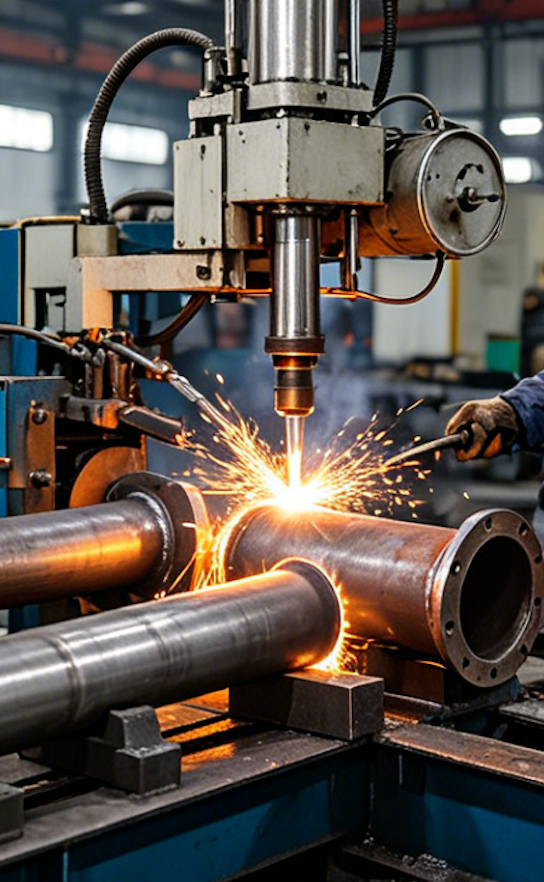
Automatic double-arm welding machine used to build Hongchang concrete pump straight pipe bodies. Image: Hongchang Machinery Technology Co., Ltd.
Elbows: 150R400*90° — Cast Steel, Double-Layer, Heat-Treated
Every horizontal run eventually has to turn, and the elbow is where wear concentrates. The designation 150R400*90° reads as: DN150 bore (150), 400 mm bend radius (R400), and a 90° turn (*90°). Hongchang's 150R400 elbow is a heat-treated cast steel double-layer elbow, available in 90°, 45°, 30°, and 15° angles.
Two specification words in that sentence carry most of the meaning. Cast steel distinguishes the elbow from a fabricated or welded bend. Double-layer indicates an inner wear layer bonded to an outer structural layer — a construction used in high-pressure delivery lines, where double-layer (twin pipe) designs are applied to handle pressures up to 85 bar and to limit abrasive wear from large aggregates (Esser Twin Pipes). Drag-aggregate mixes and long vertical lifts are the two conditions that make the double-layer option worth discussing during selection rather than after the first replacement.
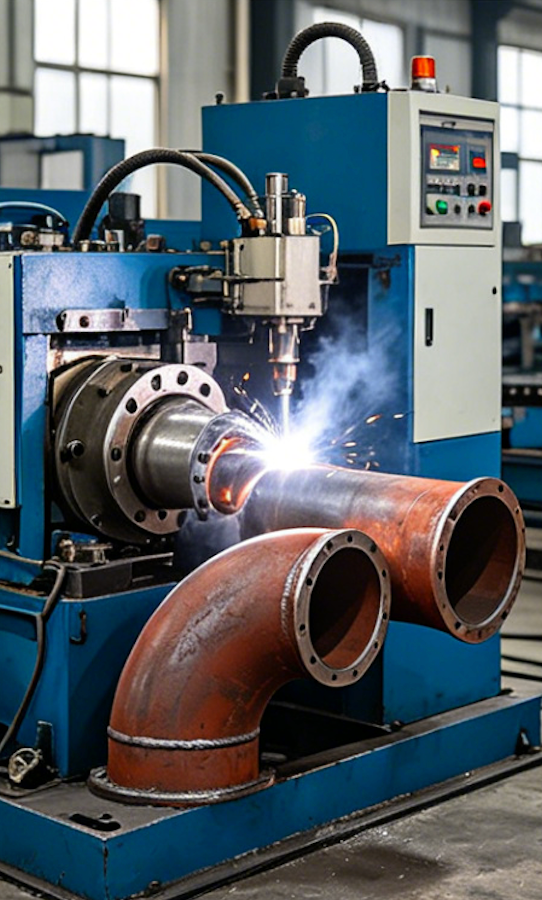
Automatic pipe bending and welding machine used in concrete pump elbow production. Image: Hongchang Machinery Technology Co., Ltd.
Reducer Pipes: 150-125 L=1200 (DN150 to DN125)
A reducer connects two different bore sizes in one line. The designation 150-125 L=1200 means the part transitions from DN150 to DN125 over a length of 1,200 mm. Reducers are what allow a pump outlet, a boom section, and a placing line of different diameters to work as one system — a common requirement when a ground pump feeds a line originally sized for a different section of the pour.
For buyers, the reducer is also a documentation checkpoint. Because it changes line diameter, it changes flow velocity and pressure at that point, so the reducer's bore pair, length, and material should match the adjoining straight pipes and be recorded in the parts list alongside them.
Clamps: 150A — Integral-Cast, Compatible with DN100 to DN150
Clamps are the parts nobody specifies carefully until a joint leaks. The 150A clamp is integral-cast and compatible with DN100 to DN150 pipe. Integral casting matters because a clamp is a load-bearing component: it transmits the full pressure of the line and takes the mechanical shock every time the pump strokes.
Because one clamp size covers a bore range, the 150A is the part that makes a mixed-diameter line practical — DN150 straight pipe, a 150-125 reducer, and a DN125 downstream section can all be coupled with the same clamp family. This is also why clamps belong in the long-term spares plan rather than the initial order only: they are the lowest-cost component per joint and the highest-consequence one if a replacement is not on site.
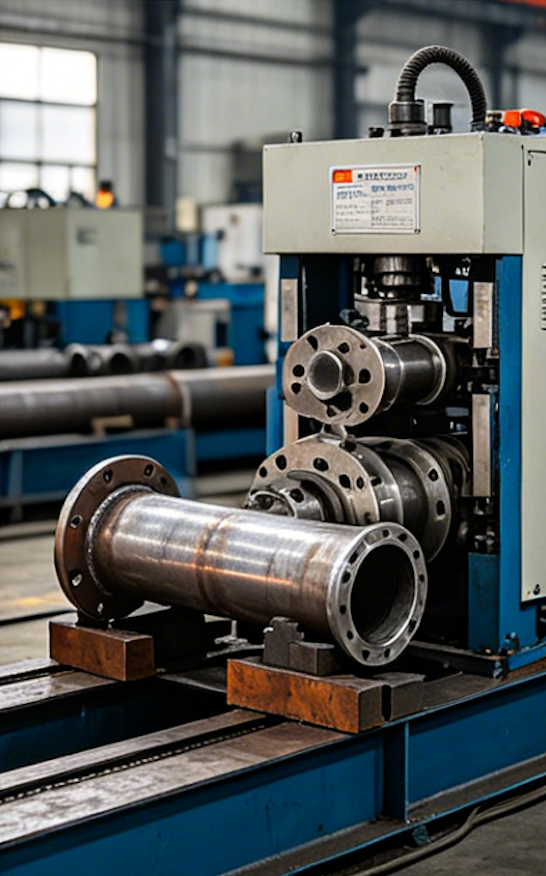
Hydraulic sleeveing machine used in the production of concrete pump pipe and clamp fittings. Image: Hongchang Machinery Technology Co., Ltd.
How to Read Concrete Pump Pipe Specifications: DN Size, Length, Bend Radius, and Angle
Every code on a delivery-line drawings sheet decomposes into four readable elements. The table below is the decoder buyers can apply to any supplier's catalogue.
| Code element | What it means | Example | Why it matters in procurement |
|---|---|---|---|
| Bore / DN size | Nominal internal diameter of the pipe | 150 = DN150 | Sets flow capacity and must match adjoining parts and clamps |
| Length (L) | Overall length of the component | L=3000 = 3,000 mm | Determines how many sections a given run needs and how many joints are created |
| Bend radius (R) | Radius of the elbow's curve | R400 = 400 mm radius | Affects resistance and where abrasion concentrates in the bend |
| Angle | Degrees of direction change | 90°, 45°, 30°, 15° | Determines layout options for routing a line around structures |
| Material | Base steel grade | 20# steel or alloy structural steel | Defines the base for wear resistance and weldability |
| Hardness | Inner-wall hardness after heat treatment | HRC 55–62 after quenching | The most direct indicator of wear life against abrasive mixes |
Step-by-Step: How Straight Pipes, Elbows, Reducers, and Clamps Are Made and Checked
Specifications only become trustworthy when the process behind them is visible. In Hongchang's 2,600 m² facility in Ma'anshan — a company founded in 2015 with more than 50 employees and an in-house design and R&D team — the production sequence for straight pipes and curved pipes runs through the following stages.
- 1. Raw material selection and batch certification. Material defects are controlled at the source through supplier qualification and raw material testing, and a certificate of quality is issued for each batch.
- 2. Cutting to length. Double-arm sawing machines cut pipe to the specified lengths, such as the 3,000 mm straight pipe section.
- 3. Forming and welding. Automatic pipe bending and welding machines form elbows, while hydraulic sleeveing and automatic double-arm welding equipment build the pipe bodies and fittings.
- 4. Quenching and heat treatment. Numerical-control high-frequency heat treatment raises inner-wall hardness into the HRC 55–62 band, and heat treatment is also applied to the cast steel double-layer elbows.
- 5. Quality control. Production runs multiple QC checkpoints with 100% inspection, pressure testing, and hardness verification rather than relying on spot checks.
- 6. Buffering and despatch. Common sizes are held in a buffer stock equivalent to roughly 30% of typical demand so that repeat orders and urgent replacement parts are not queued behind new production.
Annual output at the facility is approximately 50,000 meters of straight pipes and 15,000 curved pipes. Typical production lead time is 15–30 days.
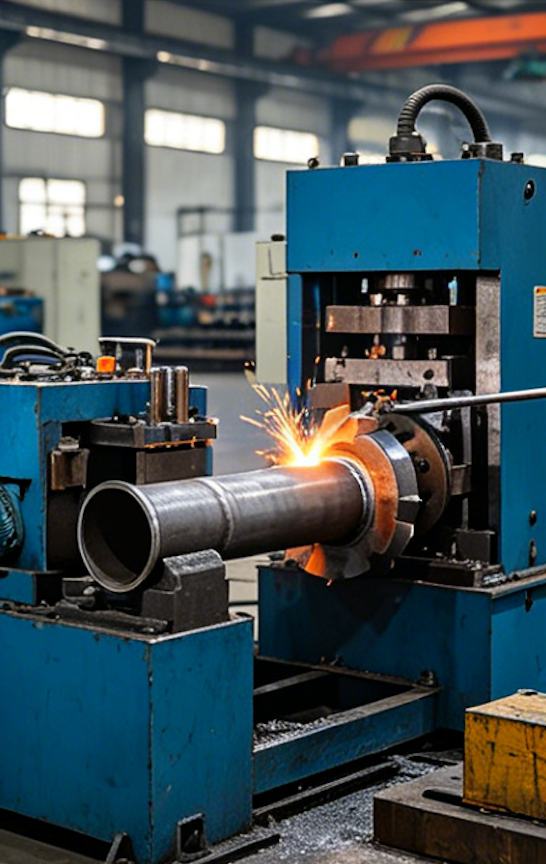
Double-arm sawing machine cutting concrete pump pipe to specified length. Image: Hongchang Machinery Technology Co., Ltd.
Where Each Component Goes: High-Rise, Tunnel, Bridge, Mining, and Pump Truck Applications
The same four components are configured differently depending on the application, and matching the configuration to the job is the second half of specification work.
- High-rise building construction. Vertical high-pressure conveying lines put continuous pressure on joints and bends, so double-layer cast steel elbows and quenched straight pipe are the relevant choices, and clamp quality becomes as important as pipe quality.
- Tunnel construction. Long horizontal runs and tight routing demand multiple elbow angles — 90°, 45°, 30°, and 15° — so that the line can follow the tunnel profile with the fewest joints possible. Wear-resistant pipe grades are typically selected for the abrasion-heavy sections.
- Bridge and infrastructure works. Large-diameter lines and reducers are used to move high volumes across long distances, with reducers tying pump outlets and placing lines of different bores into one system.
- Mining and mortar conveying. Abrasive and fine-aggregate mixes place a premium on inner-wall hardness, which is where the quenched HRC 55–62 specification is most directly tested.
- Pump truck and tow pump manufacturing. Here the components are original-equipment parts rather than replacements. Hongchang is a designated supporting manufacturer for Xingma Automobile, and its pipes can be matched with pump trucks and tow pumps from companies such as Sany Heavy Industry and Zhonglian Heavy Industry. Sany Heavy Industry was identified as the world's largest concrete pump equipment manufacturer by volume as of 2024 in an industry report by Jewinner Parts.
Ground pump special pipe, vehicle pump pipe, and long-distance conveying pipe are all variations of the same four-component logic: bore and pressure determine the straight pipe, routing determines the elbows, the pump outlet determines the reducer, and joint count determines how many clamps the site must hold in stock.
Wear-Resistant vs Standard Concrete Pump Pipe: A Component-Level Comparison
Wear-resistant and standard pipe are not interchangeable on cost alone. The comparison below uses Hongchang's own component comparison data against a generic concrete pump pipe, so the figures should be read as manufacturer-stated performance characteristics rather than independent test results.
| Comparison dimension | Hongchang quenched / double-layer pipe | Generic concrete pump pipe |
|---|---|---|
| Service life | 2–3× the lifespan of ordinary products (company statement) | Reference baseline |
| Wear rate | Approximately 20% lower wear rate (company comparison data) | Reference baseline |
| Inner-wall hardness | HRC 55–62 after quenching | Not specified in the reference data |
| Heat treatment | Numerical-control high-frequency heat treatment | Not specified in the reference data |
| Initial cost | About 15% higher initial cost than generic pipe (company comparison data) | Reference baseline |
| Maintenance impact | Reduced maintenance frequency and less downtime | Reference baseline |
The decision rule this table supports is straightforward: the higher initial cost of a quenched, double-layer component is weighed against replacement frequency, joint downtime, and the labour cost of changing pipe on an active pour. The relevant unit for comparison is therefore cost per cubic metre conveyed over the life of the line, not cost per metre purchased.
From First Order to Long-Term Supply: Building a Parts Ecosystem
A delivery line is a system, and systems are maintained by supply relationships rather than one-off purchases. Three practical elements make that relationship work.
Standardise the component set. Fixing one bore range, one clamp family (the 150A clamp covering DN100 to DN150), and a small number of elbow angles keeps spares interchangeable across machines and sites, and reduces the number of line items a store has to track.
Plan for replacement, not just installation. Straight pipe, elbows, and clamps wear at different rates. Buffer stock on common sizes and technical documentation covering installation guidance and spare parts supply is what keeps a pour moving when one section goes out of service.
Fix the commercial terms up front. For Hongchang, the minimum order quantity is 1 piece so that sample orders are possible; delivery terms are FOB, CIF, or EXW; acceptance can include pre-shipment inspection and third-party testing through SGS or BV; and payment terms are 30% deposit with 70% before shipment, by T/T or L/C. Technical support is available 24/7 remotely.
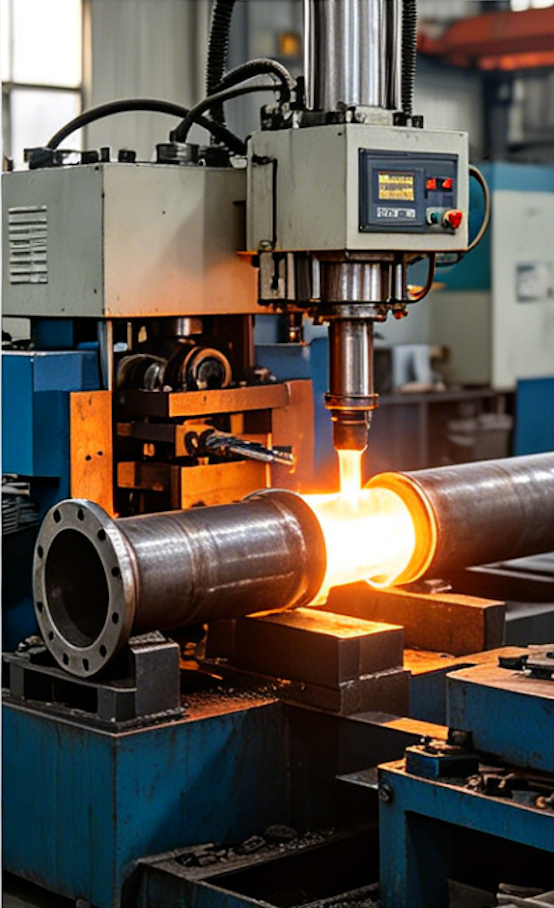
Numerical-control high-frequency heat treatment machine used to quench concrete pump pipe to HRC 55–62. Image: Hongchang Machinery Technology Co., Ltd.
FAQ: Concrete Pump Pipes, Elbows, Reducers, and Clamps
Are these components made to a recognised quality standard?
European projects commonly reference EN 12001:2012, the standard that specifies safety requirements for machines used to convey, spray, and place concrete and mortar, so it is worth confirming which documentation a project specification requires. Hongchang's own quality control is built on ISO-style process control with multiple QC checkpoints and 100% inspection, including pressure testing and hardness verification, and a certificate of quality is issued for each material batch. Buyers who need third-party confirmation can request pre-shipment inspection or SGS/BV testing as part of the acceptance process.
Can one supplier cover an entire delivery line — straight pipes, elbows, reducers, and clamps?
Yes. Hongchang's main products are concrete pump pipes, elbows, clamps, and reducers, produced at an annual output of approximately 50,000 meters of straight pipes and 15,000 curved pipes. The range includes DN150 straight pipe (150L=3000), heat-treated cast steel double-layer elbows in 90°, 45°, 30°, and 15° (150R400*90°), reducers from DN150 to DN125 (150-125 L=1200), and integral-cast 150A clamps compatible with DN100 to DN150. The company is a designated supporting manufacturer for Xingma Automobile, and its pipes can be matched with pump trucks and tow pumps from manufacturers such as Sany Heavy Industry and Zhonglian Heavy Industry.
Do wear-resistant pipes cost more, and how should that extra cost be evaluated?
Wear-resistant components carry a higher purchase price. In Hongchang's own component comparison, a quenched double-layer pipe is stated at about 15% higher initial cost than a generic concrete pump pipe, with approximately 20% lower wear rate and a service life described as 2–3× that of ordinary products. The evaluation logic follows from those numbers: compare the total cost per cubic metre conveyed across the life of the line, including replacement labour and the downtime cost of stopping a pour, rather than comparing the unit price of a single pipe section.
Can I test a sample before committing to a full order?
Yes. The minimum order quantity for sample orders is 1 piece, which allows a buyer to inspect dimensions, hardness, weld quality, and clamp fit before scaling up. Typical production lead time on standard orders is 15–30 days, and acceptance can include pre-shipment inspection and third-party testing through SGS or BV where the project requires it.
What lead time and supply support should a long project expect?
Typical production lead time is 15–30 days, supported by buffer stock equivalent to roughly 30% of typical demand on common sizes, so repeat and replacement orders do not have to wait behind new production. Technical documentation, installation guidance, spare parts supply, and 24/7 remote technical support are part of the supply arrangement. To request a sample, a quotation, or a specification review for your line, contact Hongchang Machinery Technology Co., Ltd. through hongchangpumpipe.com, by email at chenzhen@hongchangpumpipe.com, or on WhatsApp at +86-13301770177, quoting the bore, length, radius, angle, and material for each line item.
Conclusion: The Parts List Is a System, Not a Shopping Cart
Straight pipes, elbows, reducers, and clamps are described by a compact set of codes — bore, length, radius, angle, material, and hardness — and those six elements are the difference between a delivery line that runs and a delivery line that leaks. Read in that order, a specification sheet becomes a purchasing decision rather than a guessing game.
The second lesson is longer-term. A delivery line is consumed over the life of a pump, not bought once. Standardising on a component set, holding clamps and common sections in stock, and working with a supplier who documents material batches and supports replacement parts is what keeps vertical pours, tunnel runs, and infrastructure works on schedule. That combination of clear specification and dependable resupply is what a 101-level understanding of concrete pump pipes is ultimately for.
Request a Sample or Specification Review
Send your line items — bore, length, radius, angle, material, and hardness requirement — to Hongchang Machinery Technology Co., Ltd. and receive a component quotation against the sizes you actually run. Samples are available from 1 piece, with typical lead time of 15–30 days. Website: www.hongchangpumpipe.com | Email: chenzhen@hongchangpumpipe.com | WhatsApp: +86-13301770177 | Address: No. 2063, Hongqi South Road, Development Zone, Ma'anshan City, Anhui Province, China.
Have Questions or Need More Details?
Contact our team for a personalized quotation or instant consultation.
Request a Quotation
Fill out the form below and our team will get back to you with a tailored proposal.
WhatsApp Direct Chat
Prefer to chat in real-time? Message us on WhatsApp for instant assistance & quick answers.
- Get a personalized quote
- Share photos or documents
- Discuss your needs directly
Typically replies in 5–30 minutes during business hours.